The Gujarat government introduced new guidelines in 2026 requiring farmers to provide specific documents while purchasing diesel for agricultural purposes. The move was implemented amid increased demand for diesel during the farming season and concerns about fuel hoarding, unauthorized resale, and supply management. Under these rules, farmers must establish both their identity and their agricultural eligibility before purchasing diesel meant for farming operations.
For thousands of farmers across Gujarat, diesel remains essential for tractors, water pumps, harvesting equipment, and other agricultural machinery. Therefore, understanding these requirements has become important to avoid inconvenience at petrol pumps and ensure uninterrupted farming activities.
Why Were These Rules Introduced?
During the 2026 sowing season, several districts in Gujarat witnessed heavy demand for diesel. Long queues at petrol pumps and concerns about fuel shortages prompted authorities to introduce verification measures. The government directed fuel stations to sell diesel for agricultural purposes only after verifying supporting documents from farmers.
The objective behind the policy was to:
- Ensure diesel reaches genuine farmers.
- Prevent panic buying and stockpiling.
- Stop unauthorized commercial use of agricultural diesel.
- Maintain fair fuel distribution during peak agricultural seasons.
- Create proper records of diesel purchases at petrol pumps.
Five Documents Farmers Must Carry While Buying Diesel
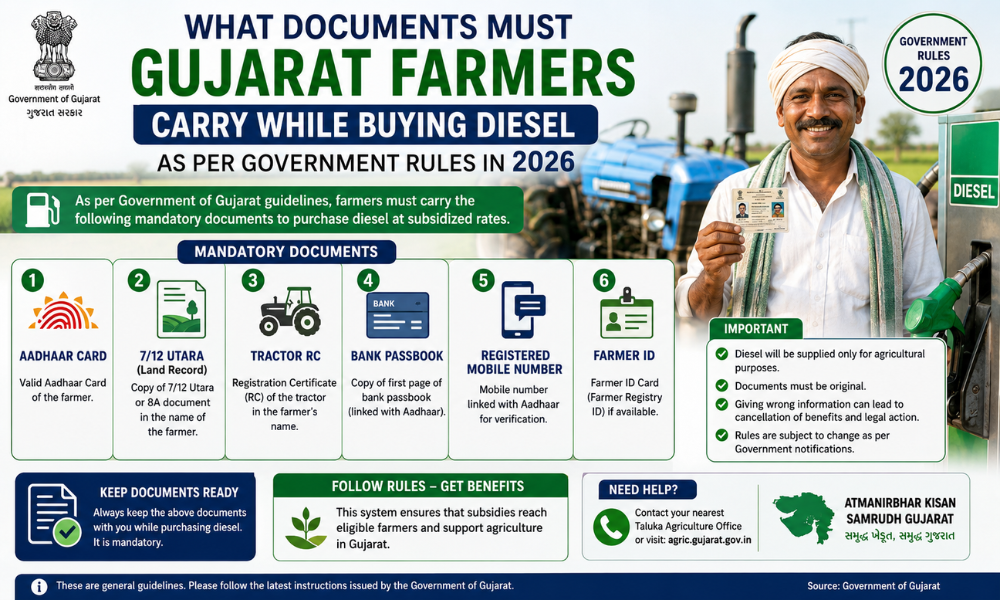
According to the guidelines highlighted in the government advisory, farmers should keep the following five documents ready when purchasing diesel for agricultural use.
- 7/12 Land Record Copy
The 7/12 extract is one of the most important land ownership documents for farmers. It contains details regarding land ownership, survey numbers, cultivation information, and crop records.
This document helps petrol pump operators verify that the buyer is an actual farmer and owns or cultivates agricultural land.
Farmers are advised to carry:
- Original copy or certified copy.
- Recent and updated record.
- Legible document showing ownership details.
The 7/12 extract serves as primary proof of agricultural activity.
- Form 8-A Land Record
Along with the 7/12 extract, farmers may also be asked to submit the 8-A land record document.
The 8-A document provides:
- Land account details.
- Ownership records.
- Revenue-related information.
- Agricultural holding information.
This additional verification helps authorities confirm land ownership and farming eligibility.
Carrying both the 7/12 extract and Form 8-A can make the verification process smoother at fuel stations.
- Aadhaar Card
The Aadhaar Card is required as an identity proof.
It helps verify:
- Farmer’s name.
- Address.
- Unique identification details.
- Authenticity of the purchaser.
Since Aadhaar is linked with numerous government databases and schemes, it serves as a reliable identity document during diesel purchases.
Farmers should ensure:
- Aadhaar details are updated.
- The card is readable.
- A photocopy is available if required.
Many petrol pumps may keep records of submitted documents for verification purposes.
- Voter ID Card (Election Card)
The Election Commission-issued Voter ID Card is another accepted proof of identity.
It is used to:
- Confirm the farmer’s identity.
- Cross-check personal details.
- Verify local residency information.
While Aadhaar remains the primary identity document, the Voter ID serves as an additional supporting proof under the guidelines.
Keeping both documents together can help avoid delays in verification.
- Tractor Registration Certificate (RC Book)
The Registration Certificate (RC Book) of the tractor is the fifth important document.
This document confirms:
- Ownership of the tractor.
- Vehicle registration details.
- Agricultural use of the vehicle.
Since diesel is being purchased specifically for farming equipment and tractors, authorities require proof that the fuel is intended for agricultural purposes.
Farmers should carry:
- Original RC Book or
- Valid copy of the registration certificate.
The RC helps fuel stations verify the legitimate use of diesel.
Is There a Limit on Diesel Purchase?
Yes. According to the guidelines, even after document verification, a farmer can generally purchase up to 200 litres of diesel at a time. This limit was introduced to ensure equitable distribution and prevent excessive stockpiling during periods of high demand.
The quantity may vary if future government notifications modify the policy, but the 200-litre cap became one of the key aspects of the 2026 diesel distribution guidelines.
What Should Farmers Do Before Visiting a Petrol Pump?
To avoid inconvenience, farmers should follow a few practical steps:
Keep Document Copies Ready
Maintain photocopies of all required documents in a dedicated file.
Carry Original Identification
Always keep original Aadhaar and Voter ID cards available for verification.
Check Land Records
Ensure that 7/12 and 8-A records are updated and reflect current ownership details.
Verify Tractor Registration
Make sure the RC Book is valid and easily accessible.
Plan Fuel Requirements
Estimate diesel requirements in advance to avoid multiple trips.
How Do These Rules Affect Farmers?
The guidelines have received mixed reactions.
Some farmers believe the documentation process creates additional paperwork during busy agricultural seasons. Others acknowledge that verification can help ensure diesel reaches genuine agricultural users and prevents misuse. Reports from various regions indicated that authorities introduced the measures primarily to regulate supply and avoid artificial shortages.
For genuine farmers, the best approach is to keep all required documents organized and readily available.
Importance of Proper Documentation
Agriculture increasingly depends on official documentation for accessing subsidies, crop insurance, government schemes, loans, and agricultural inputs. Keeping records updated not only helps in diesel purchases but also supports participation in various farmer welfare programs.
Proper documentation can help farmers:
- Access government benefits.
- Obtain agricultural subsidies.
- Apply for crop-related assistance.
- Verify land ownership when required.
- Complete banking and insurance procedures smoothly.
Conclusion
Under Gujarat’s 2026 diesel purchase guidelines, farmers must carry five key documents while buying diesel for agricultural use:
- 7/12 Land Record Copy
- Form 8-A Land Record
- Aadhaar Card
- Voter ID Card
- Tractor RC Book
These documents help verify the farmer’s identity, land ownership, and agricultural requirements. Additionally, diesel purchases are generally capped at 200 litres per transaction under the prevailing rules. By keeping these documents ready before visiting a petrol pump, farmers can save time, avoid delays, and ensure uninterrupted access to fuel for their farming operations.