Power cuts can be frustrating, especially when they interrupt work, studies, household chores, or essential appliances. Whether you live in a city apartment, a suburban home, or a rural area, having a reliable power backup system is becoming increasingly important. When exploring backup options, most homeowners come across three popular choices: generators, inverters, and solar systems.
Each solution has its own advantages, limitations, installation costs, and long-term benefits. The right choice depends on your electricity consumption, budget, power outage frequency, and future energy goals. Understanding the differences between these systems can help you make a smart investment for your home.
Why Do You Need a Power Backup System?
Electricity powers almost every aspect of modern life. From lights and fans to refrigerators, televisions, computers, and air conditioners, households depend heavily on a continuous power supply.
A backup system can help you:
- Stay comfortable during power outages
- Protect electronic devices from sudden shutdowns
- Continue working from home without interruption
- Keep essential appliances running
- Reduce dependence on the power grid
Let’s compare the three most common power backup options available today.
Generator: The Traditional Backup Solution
Generators have been used for decades as a dependable source of electricity during long power cuts. They operate using fuels such as diesel, petrol, natural gas, or LPG.
How Does a Generator Work?
A generator converts mechanical energy into electrical energy through an internal combustion engine. When the electricity supply stops, the generator starts and produces power independently.
Advantages of Generators
High Power Output
Generators can handle heavy electrical loads including:
- Air conditioners
- Water pumps
- Refrigerators
- Washing machines
- Motors
- Multiple household appliances simultaneously
Suitable for Long Power Cuts
If your area experiences outages lasting several hours, a generator can provide uninterrupted electricity as long as fuel is available.
Immediate Power Supply
Generators can start within seconds and provide instant backup.
Limitations of Generators
- Require diesel or petrol regularly
- Produce noise during operation
- Need periodic maintenance
- Generate air pollution
- Fuel costs increase operating expenses
Best For
Generators are ideal for homes in areas with frequent and extended power outages where running heavy appliances is essential.
Inverter and Battery System: The Most Popular Home Backup Option
Inverters are among the most commonly used backup systems in residential properties. They store electricity in batteries and supply power during outages.
How Does an Inverter Work?
When electricity is available, the inverter charges its battery. During a power cut, the stored energy is converted into usable electricity for household appliances.
Advantages of Inverters
Silent Operation
Unlike generators, inverters operate almost silently.
Automatic Switching
Power transitions occur automatically, often within milliseconds.
Low Maintenance
Inverters generally require less maintenance compared to generators.
Cost-Effective
The initial investment is lower than installing a complete solar power system.
Limitations of Inverters
- Limited backup duration
- Battery replacement required after several years
- Cannot support heavy loads for long periods
- Performance depends on battery capacity
Best For
Inverters are suitable for apartments, small homes, and urban households that experience occasional power cuts lasting a few hours.
Solar Power System: The Future of Home Energy
Solar power has become one of the fastest-growing energy solutions worldwide. By converting sunlight into electricity, solar systems provide both backup power and long-term savings.
How Does a Solar System Work?
Solar panels capture sunlight and convert it into electricity. The generated power can be:
- Used immediately
- Stored in batteries
- Exported to the grid in grid-connected systems
Advantages of Solar Systems
Significant Electricity Savings
Solar energy reduces dependence on utility electricity, resulting in lower monthly bills.
Environment-Friendly
Solar systems generate clean energy without producing harmful emissions.
Government Incentives
Many regions offer subsidies, tax benefits, or financial assistance for solar installations.
Long Lifespan
Quality solar panels can operate efficiently for 25 to 30 years.
Energy Independence
Solar users become less dependent on rising electricity prices.
Limitations of Solar Systems
- Higher initial installation cost
- Requires sufficient roof space
- Performance depends on sunlight availability
- Battery systems increase project cost
Best For
Solar power is ideal for homeowners seeking long-term savings, environmental benefits, and energy independence.
Cost Comparison
One of the most important factors when selecting a backup solution is the overall cost.
Generator
- Lower installation cost
- Ongoing fuel expenses
- Regular maintenance costs
- Higher operating costs over time
Inverter
- Moderate upfront investment
- Battery replacement every few years
- Lower operating expenses
Solar System
- Highest initial investment
- Minimal operating costs
- Long-term savings on electricity bills
- Strong return on investment over time
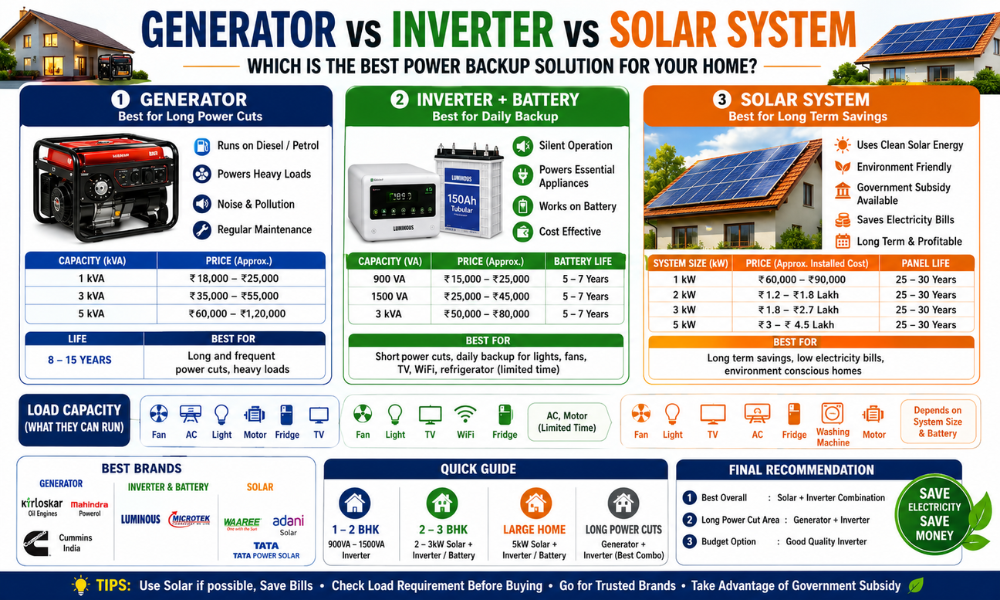
While solar systems may appear expensive initially, they often become the most economical option over a period of 8 to 10 years.
Which System Can Power More Appliances?
Generator
Can typically operate:
- Lights
- Fans
- Refrigerators
- Air conditioners
- Water pumps
- Motors
- Entire home loads
Inverter
Best suited for:
- Lights
- Fans
- Television
- Wi-Fi router
- Laptop
- Refrigerator
Heavy appliances may significantly reduce backup time.
Solar System
Depending on system size, solar can power:
- Entire household loads
- Refrigerators
- Air conditioners
- Washing machines
- Water pumps
- Home office equipment
A properly designed solar setup can meet most residential energy requirements.
Maintenance Requirements
Generator
Requires:
- Fuel management
- Oil changes
- Engine servicing
- Periodic inspections
Inverter
Requires:
- Battery water checks for tubular batteries
- Battery replacement after several years
Solar System
Requires:
- Occasional panel cleaning
- Routine system inspection
- Minimal maintenance overall
Solar systems generally have the lowest maintenance requirements among the three options.
Which Backup Solution Is Best for Different Home Sizes?
1–2 BHK Homes
For smaller households with moderate electricity needs, an inverter with a suitable battery capacity is often sufficient.
3–4 BHK Homes
A combination of solar power and inverter backup can provide reliable electricity while reducing monthly energy costs.
Homes with Heavy Power Consumption
If your household frequently uses air conditioners, pumps, and multiple appliances simultaneously, a larger solar system or a generator-inverter combination may be more effective.
Newly Constructed Homes
Installing solar panels during construction is often a wise investment because it allows better system integration and future savings.
Solar + Inverter: A Smart Combination
Many energy experts recommend combining solar panels with an inverter and battery system.
This setup offers:
- Daytime solar power generation
- Battery backup during outages
- Reduced electricity bills
- Increased energy independence
- Better utilization of renewable energy
The combination provides both immediate backup and long-term financial benefits.
Final Verdict: Which Option Should You Choose?
There is no single answer that fits every household. The best solution depends on your specific needs.
Choose a Generator If:
- Power cuts are frequent and lengthy.
- You need to run heavy appliances.
- Fuel availability is not a concern.
Choose an Inverter If:
- You want affordable backup power.
- Outages are short and occasional.
- You need power for essential appliances.
Choose a Solar System If:
- You want long-term savings.
- You care about sustainability.
- You want to reduce electricity bills significantly.
The Best Overall Choice
For most modern households, a solar system combined with an inverter and battery backup offers the best balance of reliability, savings, and environmental responsibility. While the initial investment may be higher, the long-term benefits often outweigh the costs.
As electricity prices continue to rise and renewable energy becomes more accessible, solar power is increasingly emerging as the preferred choice for homeowners looking to secure their energy future while saving money for years to come.