Medical tests play a crucial role in modern healthcare. They help doctors diagnose illnesses, monitor ongoing health conditions, assess the effectiveness of treatments, and even detect diseases before symptoms appear. However, many people are unsure about when a medical test is actually necessary and which test is appropriate for a particular health concern.
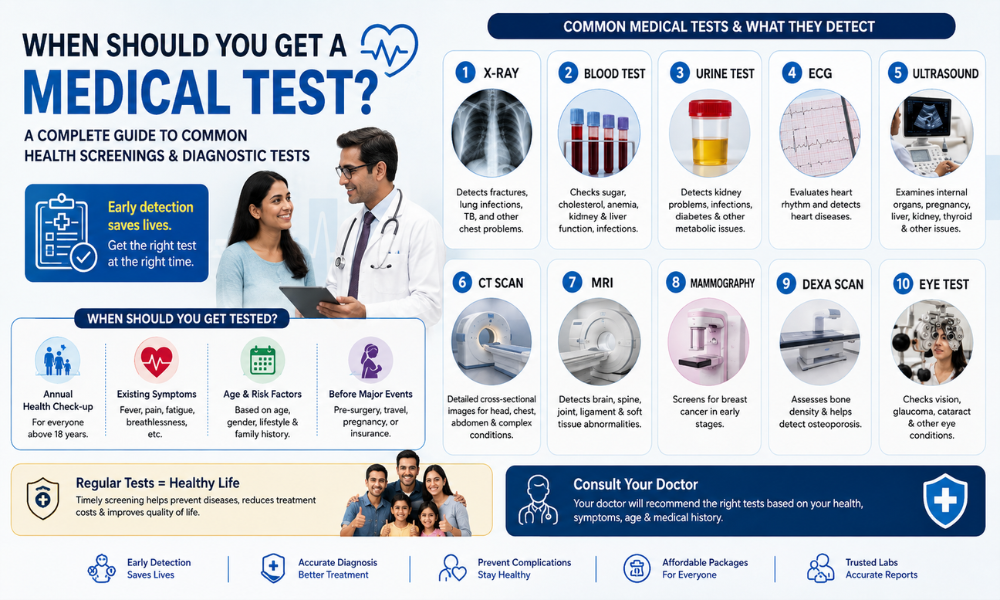
From routine blood tests to advanced imaging techniques like X-rays, CT scans, MRI, ultrasound, PET scans, mammography, DEXA scans, fluoroscopy, and angiography, each diagnostic test serves a unique purpose. The infographic above highlights several of the most commonly used imaging and diagnostic tests, along with their general applications.
This guide explains the importance of common medical tests, when they are typically recommended, and what patients should know before undergoing them.
Important Note: Medical tests should always be performed only when recommended by a qualified healthcare professional. This article is for educational purposes and should not replace medical advice.
Why Are Medical Tests Important?
Medical tests help healthcare providers gather information that cannot always be determined through a physical examination alone. They allow doctors to:
- Confirm or rule out medical conditions.
- Detect diseases at an early stage.
- Monitor chronic illnesses.
- Assess injuries after accidents.
- Guide treatment decisions.
- Evaluate recovery after surgery or medication.
Early diagnosis often leads to better treatment outcomes, making timely testing an important part of preventive healthcare.
When Should You Consider a Medical Test?
Doctors may recommend diagnostic tests in several situations, including:
- Persistent pain or unexplained symptoms.
- Fever lasting several days without a clear cause.
- Sudden weakness or numbness.
- Difficulty breathing or chest discomfort.
- Head injuries or fractures.
- Routine health check-ups based on age or risk factors.
- Monitoring chronic conditions such as diabetes, heart disease, or osteoporosis.
- Cancer screening for individuals in recommended age groups.
Rather than requesting tests on your own, it is best to consult a healthcare provider who can determine which investigation is appropriate.
Common Medical Imaging and Diagnostic Tests
The image above features several widely used diagnostic procedures. Here’s an overview of each.
- X-Ray
An X-ray is one of the oldest and most commonly used imaging tests. It uses a small amount of radiation to produce images of bones and certain internal structures.
Doctors commonly recommend X-rays for:
- Suspected bone fractures
- Joint injuries
- Chest infections such as pneumonia
- Dental problems
- Certain lung conditions
The procedure is quick and usually completed within a few minutes.
- CT Scan (Computed Tomography)
A CT scan combines multiple X-ray images with computer processing to create detailed cross-sectional views of the body.
It is commonly used to evaluate:
- Head injuries
- Internal bleeding
- Tumors
- Lung diseases
- Abdominal conditions
- Complex fractures
CT scans provide more detailed images than standard X-rays but involve higher radiation exposure.
- MRI (Magnetic Resonance Imaging)
MRI uses powerful magnets and radio waves instead of X-rays to produce highly detailed images of soft tissues.
Doctors may recommend MRI for:
- Brain disorders
- Spine problems
- Ligament injuries
- Joint conditions
- Muscle damage
- Certain cancers
Because MRI does not use ionizing radiation, it is often preferred for detailed soft tissue evaluation when appropriate.
- Ultrasound
Ultrasound uses high-frequency sound waves to create real-time images of internal organs.
It is widely used for:
- Pregnancy monitoring
- Liver and kidney evaluation
- Gallbladder examination
- Thyroid assessment
- Pelvic conditions
- Blood flow studies
Ultrasound is painless, radiation-free, and considered safe for many patients, including pregnant women.
- PET Scan
A Positron Emission Tomography (PET) scan helps evaluate how organs and tissues function by using a small amount of radioactive tracer.
Doctors may recommend PET scans for:
- Cancer diagnosis and staging
- Monitoring treatment response
- Detecting cancer recurrence
- Certain neurological disorders
- Some heart conditions
PET scans are generally reserved for specific clinical situations rather than routine screening.
- Fluoroscopy
Fluoroscopy provides continuous moving X-ray images, allowing doctors to observe organs and body functions in real time.
It may be used during:
- Digestive system evaluations
- Joint procedures
- Catheter placements
- Orthopedic surgeries
- Certain cardiovascular procedures
- Mammography
Mammography is a specialized low-dose X-ray designed to examine breast tissue.
It is commonly used for:
- Breast cancer screening
- Evaluating breast lumps
- Monitoring breast health in high-risk individuals
Regular screening recommendations vary by age, personal risk factors, and national health guidelines.
- DEXA Scan
A DEXA (Dual-Energy X-ray Absorptiometry) scan measures bone mineral density.
Doctors often recommend it for:
- Osteoporosis screening
- Postmenopausal women
- Older adults
- Individuals at risk of bone fractures
- Long-term steroid users
The test is painless and helps assess fracture risk.
- Angiography
Angiography uses contrast dye along with imaging technology to examine blood vessels.
It helps diagnose:
- Blocked arteries
- Coronary artery disease
- Aneurysms
- Vascular abnormalities
- Reduced blood flow
Angiography may be performed using X-ray, CT, or MRI depending on the clinical situation.
Routine Health Screenings Matter Too
While imaging tests are important, routine health screenings are equally valuable for maintaining overall health.
Depending on age, family history, and lifestyle, your doctor may recommend:
- Blood pressure monitoring
- Blood sugar testing
- Cholesterol profile
- Complete blood count (CBC)
- Liver and kidney function tests
- Thyroid function tests
- Urine analysis
- Vision and hearing examinations
- Cervical cancer screening
- Prostate evaluation (when appropriate)
- Colon cancer screening for eligible adults
These screenings can identify health issues before noticeable symptoms develop.
Preparing for a Medical Test
Preparation varies depending on the type of test. Your healthcare provider may advise you to:
- Fast for several hours before certain blood tests or scans.
- Drink water before an ultrasound.
- Avoid wearing metal objects for MRI examinations.
- Inform the medical team about allergies, pregnancy, or implanted medical devices.
- Share a list of current medications.
Following these instructions helps ensure accurate results and a smoother testing process.
Understanding Your Test Results
Receiving a medical test report can be confusing without professional interpretation. It is important to remember that:
- An abnormal result does not always mean a serious disease.
- A normal report does not completely rule out every condition.
- Some findings require additional testing or follow-up.
- Results should always be interpreted alongside your symptoms, medical history, and physical examination.
Discuss your reports with a qualified doctor instead of attempting to self-diagnose.
Tips for Maintaining Good Health
Medical tests are valuable, but they are only one part of staying healthy. You can reduce the risk of many illnesses by:
- Eating a balanced diet rich in fruits, vegetables, and whole grains.
- Exercising regularly.
- Maintaining a healthy weight.
- Getting enough sleep.
- Avoiding tobacco and limiting alcohol.
- Managing stress effectively.
- Staying up to date with recommended vaccinations.
- Scheduling routine health check-ups.
Healthy lifestyle choices, combined with timely medical evaluations, contribute to better long-term well-being.
Conclusion
Medical tests are essential tools that help doctors diagnose diseases, monitor health conditions, and plan appropriate treatments. As highlighted in the infographic, common diagnostic procedures such as X-rays, CT scans, MRI, ultrasound, PET scans, fluoroscopy, mammography, DEXA scans, and angiography each have specific roles and are recommended based on individual symptoms and medical needs. They are not interchangeable, and no single test is suitable for every situation.
The key to effective healthcare is not undergoing more tests, but getting the right test at the right time under the guidance of a qualified medical professional. Combined with regular health screenings, preventive care, and a healthy lifestyle, appropriate diagnostic testing can support early detection and better treatment outcomes. If you experience persistent symptoms or have concerns about your health, consult your doctor to determine which medical evaluation is most appropriate for your individual circumstances.