
Global trade depends heavily on shipping containers that transport goods across oceans, connecting manufacturers, suppliers, and consumers worldwide. Every day, millions of containers move through ports, railways, and highways, carrying everything from electronics and clothing to food products and industrial machinery.
If you’ve ever visited a seaport or noticed containers on trains or trucks, you may have observed that they come in different colors and display various company logos. These colors are not chosen randomly—they often represent specific shipping companies and help identify container ownership quickly.
In this guide, we’ll explain how shipping container colors help identify major shipping companies, why these colors matter, and introduce some of the world’s leading container shipping lines.
Why Do Shipping Containers Have Different Colors?
Shipping containers are painted in distinctive colors primarily for branding and easy identification. Since thousands of containers move through ports every day, unique colors and logos allow shipping companies, port authorities, logistics providers, and customers to recognize containers at a glance.
Container colors also offer practical benefits, including:
- Easy identification during loading and unloading
- Strong brand recognition
- Simplified inventory management
- Reduced operational errors
- Faster logistics and cargo handling
Although colors are useful, the company logo and the unique container number remain the most reliable methods of confirming ownership.
How to Identify Shipping Companies by Container Color
Many leading global shipping companies consistently use particular color schemes on their containers. Here are some of the most recognizable examples.
-
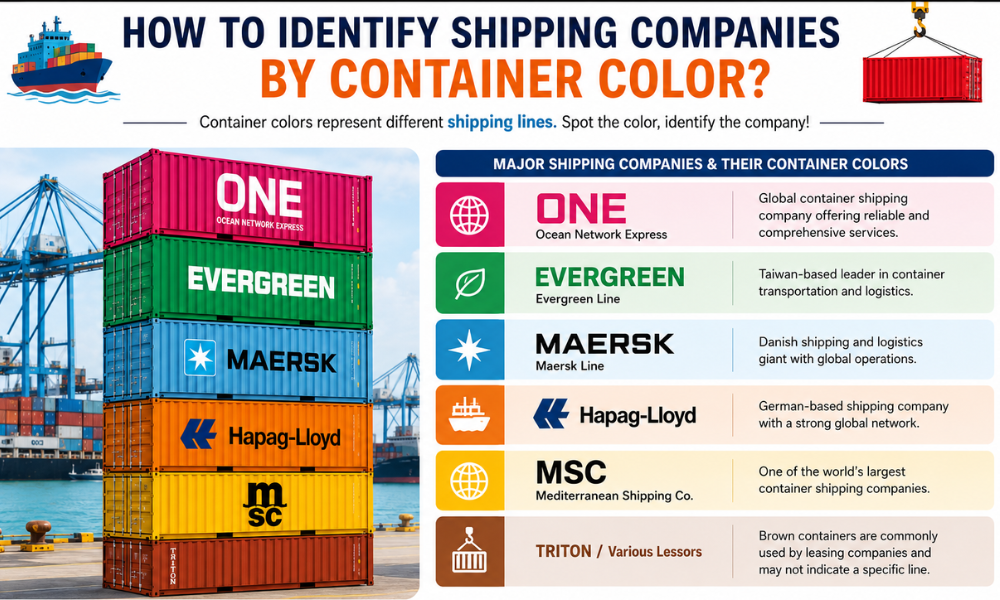
Pink Containers – Ocean Network Express (ONE)
One of the easiest shipping containers to identify is the bright magenta or pink container used by Ocean Network Express (ONE).
Founded through the merger of three major Japanese shipping companies, ONE has become one of the world’s leading container carriers. Its vibrant pink containers stand out in ports worldwide and have become a recognizable symbol of the company’s global operations.
Key Features
- Bright pink or magenta color
- Large white “ONE” logo
- Operates worldwide
- Strong presence in Asia-Europe and Trans-Pacific routes
-
Green Containers – Evergreen Line
Evergreen Line is famous for its distinctive green containers. The company is one of the largest international shipping lines and serves hundreds of ports across the globe.
Its green containers are among the most recognizable in international shipping terminals.
Key Features
- Dark green container body
- Large white EVERGREEN lettering
- Extensive worldwide shipping network
- Well-known in international logistics
-
Light Blue Containers – Maersk
Maersk is one of the world’s largest and most respected shipping companies. Its containers are typically painted in a light blue shade with the well-known white star logo.
Because of Maersk’s enormous global fleet, these containers are frequently seen in ports on every continent.
Key Features
- Light blue color
- White star logo
- Global container shipping services
- Advanced logistics and supply chain solutions
-
Orange Containers – Hapag-Lloyd
German shipping giant Hapag-Lloyd uses bright orange containers that are instantly recognizable.
The company’s bold orange branding makes identification simple, especially in busy container terminals where thousands of containers are stacked together.
Key Features
- Bright orange color
- Blue Hapag-Lloyd logo
- Strong European shipping network
- Global container transportation
-
Yellow Containers – Mediterranean Shipping Company (MSC)
Mediterranean Shipping Company, commonly known as MSC, operates one of the world’s largest container fleets.
Its yellow containers with the black MSC logo are widely seen across international ports.
Key Features
- Bright yellow color
- Black MSC logo
- Worldwide container services
- Large global shipping network
-
Brown Containers – Leasing Companies
Not every container belongs to a shipping line. Many brown or rust-colored containers are owned by container leasing companies.
Shipping companies often rent these containers instead of purchasing them outright. These leased containers may be used by multiple shipping lines depending on operational requirements.
Common characteristics include:
- Brown or rust-colored appearance
- Leasing company markings
- Used across different shipping companies
- Flexible asset for global logistics
Are Container Colors Standardized?
The simple answer is No.
There is no international regulation requiring shipping companies to use a specific color. Companies choose colors mainly for branding and visibility.
However, many shipping lines maintain consistent color schemes because they have become part of their corporate identity. Over time, these colors help customers, logistics professionals, and port workers recognize containers quickly.
Why Are Company Logos More Important Than Color?
Although color offers a quick visual clue, it should never be the only method used to identify a container.
The official company logo and the ISO container identification number provide accurate ownership information.
For example:
- Weather conditions can fade paint.
- Containers may be repainted.
- Leasing companies may provide containers to different carriers.
- Some shipping companies use containers in multiple colors.
Therefore, professionals always verify ownership using:
- Company logo
- Container identification number
- ISO 6346 container code
- Shipping documentation
Understanding Container Identification Numbers
Every shipping container has a unique identification number that follows the ISO 6346 international standard.
A typical container number looks like this:
MSCU 123456 7
This code includes:
- Owner code
- Equipment category identifier
- Serial number
- Check digit
Unlike color, this identification number remains the official method for tracking and verifying container ownership throughout its journey.
Benefits of Knowing Container Colors
Understanding container colors can be useful for many professionals involved in logistics and international trade.
Freight Forwarders
Quickly recognize shipping lines and organize shipments more efficiently.
Port Operators
Improve loading, unloading, stacking, and yard management.
Logistics Students
Gain practical knowledge about global shipping operations.
Importers and Exporters
Better understand cargo movement and identify shipping partners.
Supply Chain Professionals
Enhance operational awareness and communication across international logistics networks.
Other Popular Global Shipping Companies
In addition to ONE, Evergreen, Maersk, Hapag-Lloyd, and MSC, several other major container shipping companies operate worldwide, including:
- CMA CGM
- COSCO Shipping
- Yang Ming Marine Transport
- ZIM Integrated Shipping Services
- HMM (Hyundai Merchant Marine)
- Wan Hai Lines
- OOCL (Orient Overseas Container Line)
Each company has its own branding, logos, and container designs that help distinguish its fleet.
Tips for Identifying Shipping Containers
If you want to identify a shipping container accurately, follow these simple steps:
- Observe the container’s primary color.
- Look for the company logo.
- Read the company name printed on the container.
- Check the ISO container identification number.
- Verify shipping documents when necessary.
- Remember that leased containers may not always match a shipping company’s branding.
Conclusion
Shipping container colors are much more than decorative choices—they serve as valuable branding and identification tools in global logistics. Colors such as pink for Ocean Network Express (ONE), green for Evergreen Line, light blue for Maersk, orange for Hapag-Lloyd, and yellow for MSC have become instantly recognizable across ports worldwide.
However, while color offers a quick way to recognize a shipping line, it should always be supported by checking the company logo and the official ISO container identification number for accurate verification. Whether you are an importer, exporter, logistics professional, student, or simply interested in international trade, understanding shipping container colors provides useful insight into how the world’s largest shipping companies manage and move cargo efficiently across the globe.
As international trade continues to grow, being able to identify shipping companies by container color is a practical skill that enhances your understanding of the global supply chain and the complex logistics network that keeps goods moving every day.