
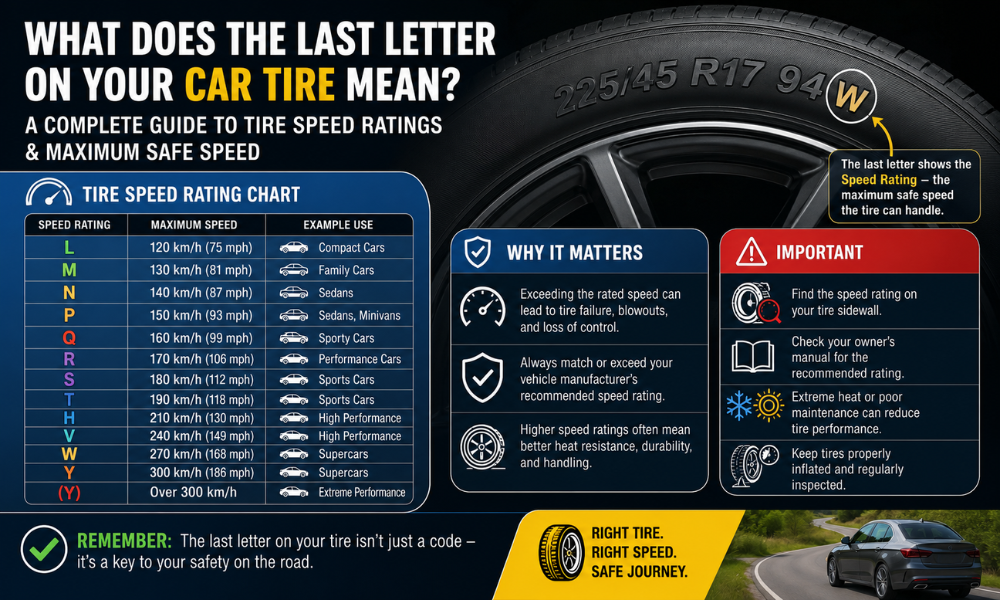
When purchasing new tires, most people focus on the tire brand, size, and price. However, one of the most important details is often overlooked—the last letter printed on the tire sidewall. This single letter represents the tire speed rating, which tells you the maximum speed the tire can safely sustain under recommended conditions.
For example, if your tire is marked 205/55 R16 96H, the final letter H is the tire’s speed rating. Understanding this rating is essential for your safety, vehicle performance, and tire longevity.
In this guide, we’ll explain what tire speed ratings mean, how to read them, and why choosing the correct speed rating is important.
What is a Tire Speed Rating?
A tire speed rating is a standardized code represented by a letter at the end of the tire specification. It indicates the maximum speed a tire can safely maintain while carrying its specified load under ideal driving conditions.
Manufacturers determine these ratings through rigorous laboratory testing. The tire is tested at increasing speeds until it reaches its certified limit while maintaining structural integrity.
It is important to understand that the speed rating is not a recommendation to drive at that speed. Instead, it reflects the tire’s engineering capability.
Where Can You Find the Speed Rating?
The speed rating appears at the end of the tire size printed on the sidewall.
Example:
205/55 R16 96H
Here’s what each part means:
- 205 – Tire width (205 mm)
- 55 – Aspect ratio (sidewall height)
- R – Radial construction
- 16 – Wheel diameter in inches
- 96 – Load Index
- H – Speed Rating
The last letter (H) indicates the tire’s maximum certified speed.
Tire Speed Rating Chart
Below is a simplified speed rating chart commonly found on passenger vehicle tires.
| Speed Rating | Maximum Speed |
| L | 120 km/h (75 mph) |
| M | 130 km/h (81 mph) |
| N | 140 km/h (87 mph) |
| P | 150 km/h (93 mph) |
| Q | 160 km/h (99 mph) |
| R | 170 km/h (106 mph) |
| S | 180 km/h (112 mph) |
| T | 190 km/h (118 mph) |
| H | 210 km/h (130 mph) |
| V | 240 km/h (149 mph) |
| W | 270 km/h (168 mph) |
| Y | 300 km/h (186 mph) |
These ratings help consumers choose tires suitable for their vehicle’s performance and intended use.
What Does “H” Mean on a Tire?
If your tire ends with the letter H, it means the tire has a maximum certified speed of 210 km/h (130 mph) under ideal testing conditions.
For example:
205/55 R16 96H
This indicates:
- Tire Width: 205 mm
- Aspect Ratio: 55
- Radial Tire
- Fits a 16-inch wheel
- Load Index: 96
- Speed Rating: H (210 km/h)
Many sedans, crossovers, and premium passenger vehicles come equipped with H-rated tires because they provide a good balance of comfort, durability, and performance.
Why Are Tire Speed Ratings Important?
Many drivers assume they will never drive at the maximum speed shown on the tire. However, speed ratings affect much more than top speed.
- Improved Safety
Speed-rated tires are engineered to withstand heat generated at higher speeds. A tire with an appropriate speed rating is less likely to overheat during long highway journeys.
- Better Vehicle Stability
Higher speed-rated tires generally provide:
- Better cornering
- Improved steering response
- Greater road grip
- Enhanced stability
This contributes to a safer and more enjoyable driving experience.
- Heat Resistance
As vehicle speed increases, tire temperature rises significantly. Tires with higher speed ratings are designed using advanced materials that can tolerate greater heat without compromising performance.
- Manufacturer Recommendations
Vehicle manufacturers carefully select tire speed ratings based on:
- Vehicle weight
- Engine power
- Suspension design
- Braking performance
- Overall safety requirements
Replacing your original tires with lower-rated tires can reduce your vehicle’s designed safety margin.
Can You Use Tires with a Higher Speed Rating?
Yes.
Installing tires with a higher speed rating than originally specified is generally acceptable, provided the tire size and load index also meet the vehicle manufacturer’s recommendations.
For example:
If your vehicle requires H-rated tires, you may choose:
- V-rated
- W-rated
- Y-rated
These tires are built to handle higher speeds and often offer improved handling characteristics.
Can You Use Tires with a Lower Speed Rating?
Generally, no.
Using tires with a lower speed rating than recommended by the vehicle manufacturer may result in:
- Reduced handling performance
- Increased heat buildup
- Longer braking distances
- Reduced stability at highway speeds
- Potential safety risks
Always consult your vehicle owner’s manual or tire professional before selecting replacement tires.
Does a Higher Speed Rating Mean a Better Tire?
Not necessarily.
A higher speed rating means the tire is designed for higher-speed performance, but it doesn’t automatically make it the best choice for every driver.
Some higher-rated tires may:
- Wear faster
- Cost more
- Deliver a firmer ride
- Be designed primarily for performance vehicles
The best tire is the one that matches your vehicle and driving needs.
Common Speed Ratings by Vehicle Type
S and T Rated Tires
Suitable for:
- Small cars
- Family sedans
- Economy vehicles
Excellent for daily commuting and city driving.
H Rated Tires
Common on:
- Mid-size sedans
- SUVs
- Crossovers
- Premium passenger cars
They offer a balance of comfort and performance.
V Rated Tires
Typically found on:
- Sports sedans
- Luxury vehicles
- Performance SUVs
They provide improved handling at higher speeds.
W and Y Rated Tires
Used on:
- High-performance sports cars
- Luxury performance vehicles
- Supercars
These tires are engineered for exceptional stability and high-speed capability.
Tips for Choosing the Right Tire
Before purchasing new tires, keep these tips in mind:
- Always match the tire size recommended by your vehicle manufacturer.
- Never ignore the load index.
- Choose the correct speed rating for your vehicle.
- Replace all four tires with matching specifications whenever possible.
- Check tire pressure regularly.
- Rotate your tires according to the recommended maintenance schedule.
- Inspect tires for uneven wear, cuts, or damage.
- Replace worn tires before they become unsafe.
Frequently Asked Questions (FAQs)
Is the speed rating the same as the vehicle’s top speed?
No. The tire speed rating indicates the tire’s tested capability, not the vehicle’s maximum speed.
Can I mix different speed ratings?
It’s generally recommended to use the same speed rating on all four tires to maintain balanced handling and stability.
Does tire pressure affect speed rating?
Yes. Underinflated tires generate more heat, which can reduce safety and performance, especially at higher speeds.
Does a higher speed rating increase fuel economy?
Not necessarily. Fuel economy depends on several factors, including rolling resistance, tire design, inflation pressure, and driving habits.
Conclusion
The last letter on your car tire is much more than just a code—it is a critical safety indicator that defines the tire’s maximum certified speed capability. Whether your tire is marked H, V, W, or Y, choosing the correct speed rating helps ensure optimal handling, stability, and reliability on the road.
When replacing tires, always follow your vehicle manufacturer’s recommendations for size, load index, and speed rating. While a higher speed-rated tire may offer enhanced performance, using a lower-rated tire than specified can compromise safety and vehicle dynamics.
By understanding tire speed ratings and selecting the right tires, you can improve your driving confidence, extend tire life through proper maintenance, and enjoy safer journeys—whether you’re commuting through the city or cruising on the highway.