
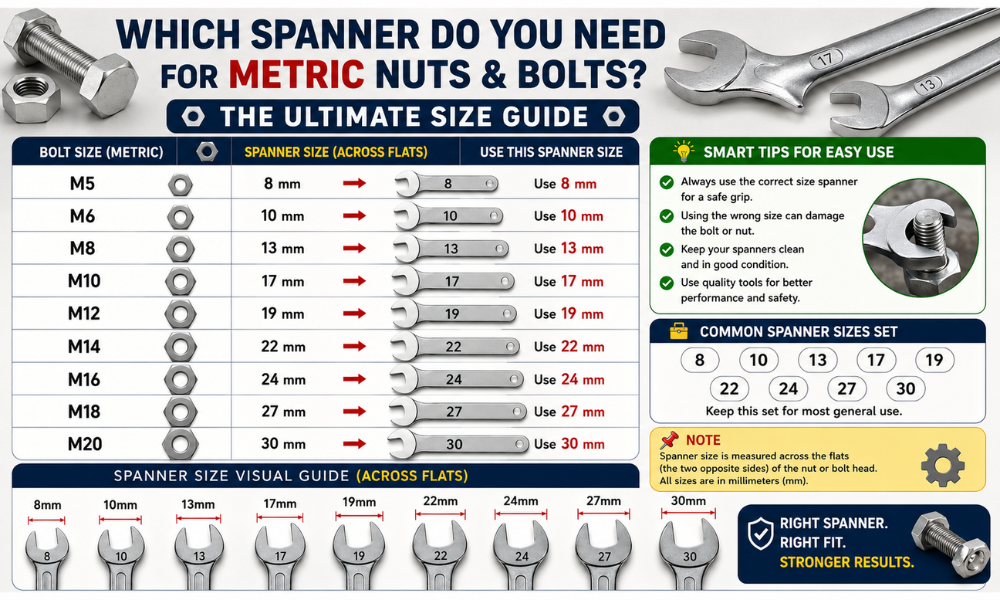
Whether you’re repairing a vehicle, assembling machinery, working on a construction project, or handling a simple DIY task at home, using the correct spanner (wrench) for your nuts and bolts is essential. One of the most common mistakes beginners make is choosing a spanner based on the bolt’s thread size rather than the size of its hexagonal head.
For example, many people assume an M10 bolt requires a 10mm spanner, but that’s incorrect. A standard M10 metric hex bolt actually requires a 17mm spanner. Understanding this difference can save time, prevent tool damage, and protect your fasteners.
This guide explains everything you need to know about selecting the right spanner for metric nuts and bolts, along with an easy-to-follow size chart.
What Does “M” Mean on a Bolt?
The letter “M” stands for Metric and refers to the diameter of the bolt’s threaded shaft, measured in millimeters.
Examples:
- M5 = 5mm thread diameter
- M6 = 6mm thread diameter
- M8 = 8mm thread diameter
- M10 = 10mm thread diameter
- M12 = 12mm thread diameter
The “M” size does not indicate the spanner size. Instead, the spanner must match the width across the flats of the bolt head or nut.
Metric Bolt to Spanner Size Chart
The following chart shows the standard spanner sizes for common metric hex bolts.
| Bolt Size | Standard Spanner Size |
| M5 | 8 mm |
| M6 | 10 mm |
| M8 | 13 mm |
| M10 | 17 mm |
| M12 | 19 mm |
| M14 | 22 mm |
| M16 | 24 mm |
| M18 | 27 mm |
| M20 | 30 mm |
This is the standard sizing used for most metric hex-head bolts manufactured according to ISO and DIN specifications.
Why Doesn’t an M10 Bolt Use a 10mm Spanner?
This is one of the most frequently asked questions.
The M10 designation only tells you the thread diameter.
The hexagonal head must be larger than the thread to provide enough strength and surface area for tightening. Therefore:
- Thread diameter = 10 mm
- Bolt head size = 17 mm
- Correct spanner = 17 mm
The same principle applies to all metric bolts.
Most Common Metric Spanner Sizes
Professional mechanics and technicians use these spanner sizes most often:
- 8 mm
- 10 mm
- 12 mm
- 13 mm
- 14 mm
- 17 mm
- 19 mm
These sizes cover a large percentage of automotive repairs, motorcycles, industrial machinery, household appliances, and general maintenance.
How to Choose the Correct Spanner
Selecting the right spanner is simple if you follow these steps.
- Identify the Bolt Size
Look for the bolt marking or measure the thread diameter.
Example:
- M6
- M8
- M10
- Refer to the Standard Size Chart
Match the bolt with its corresponding spanner size.
Example:
- M6 → 10 mm
- M8 → 13 mm
- M10 → 17 mm
- Check the Fit
The spanner should fit snugly over the bolt head without excessive movement.
A properly fitting spanner grips all six sides of the bolt head, reducing the risk of slipping.
Why Using the Correct Spanner Matters
Using the proper size isn’t just about convenience—it also protects your tools and fasteners.
Benefits include:
- Better grip on the bolt
- Easier tightening and loosening
- Reduced slipping
- Prevents rounded bolt heads
- Improves safety
- Increases tool life
- Delivers proper torque
Professional mechanics always use the exact size whenever possible.
Risks of Using the Wrong Spanner
Using an incorrect size may seem harmless, but it can create several problems.
Common issues include:
- Rounded bolt heads
- Damaged nuts
- Slipping tools
- Hand injuries
- Broken fasteners
- Inaccurate tightening torque
- Worn-out spanners
Even a difference of just 1 mm can affect the grip significantly.
Open-End vs. Ring Spanner
There are several types of spanners available.
Open-End Spanner
- Easy to position
- Works well in tight spaces
- Faster for quick adjustments
- Slightly more likely to slip under heavy force
Ring Spanner
- Surrounds the bolt completely
- Provides maximum grip
- Best for stubborn or high-torque fasteners
- Reduces the chance of rounding bolt heads
Combination Spanner
A combination spanner features:
- Open-end on one side
- Ring-end on the other
This is the most commonly used spanner in workshops because it combines convenience with strong gripping power.
Applications of Metric Spanners
Metric spanners are widely used across many industries.
Automotive Repairs
- Engine work
- Suspension
- Brake systems
- Wheel components
Industrial Machinery
- Manufacturing equipment
- Hydraulic systems
- Production machines
Construction
- Structural steel
- Heavy equipment
- Mechanical installations
Plumbing
- Pipe fittings
- Pumps
- Valves
Electrical Installations
- Cable trays
- Equipment mounting
- Control panels
Home DIY Projects
- Furniture assembly
- Bicycle maintenance
- Gardening equipment
- Household repairs
Quick Memory Tips
Remember these common combinations:
- M5 → 8 mm
- M6 → 10 mm
- M8 → 13 mm
- M10 → 17 mm
- M12 → 19 mm
These five combinations account for many of the bolts you’ll encounter in everyday mechanical work.
Are These Sizes Always the Same?
Most modern metric hex bolts follow international standards, but there are exceptions.
You may occasionally encounter:
- Heavy-duty structural bolts
- Flange bolts
- Stainless steel fasteners
- Automotive-specific bolts
- Manufacturer-specific designs
When in doubt, measure the bolt head with a Vernier calliper or test the fit with a spanner before applying force.
Tips for Longer Tool and Fastener Life
Follow these best practices to keep your tools and fasteners in good condition:
- Always use the correct spanner size.
- Clean dirt and rust from the bolt head before loosening.
- Apply penetrating oil to seized fasteners.
- Avoid using adjustable spanners when a fixed-size spanner is available.
- Use a ring spanner or socket for high-torque applications.
- Replace worn or damaged tools promptly.
- Store spanners in an organized tool kit for quick identification.
Conclusion
Choosing the correct spanner for a metric nut or bolt is a fundamental skill for mechanics, engineers, technicians, and DIY enthusiasts. Remember that the “M” size indicates the thread diameter, not the wrench size. By using a standard bolt-to-spanner size chart, you can quickly identify the correct tool, reduce the risk of damaging fasteners, and complete your work more efficiently.
Whether you’re working on a vehicle, maintaining industrial equipment, or tackling a home repair, keeping a reliable set of metric spanners and understanding the standard size chart will make every job safer, faster, and more professional.