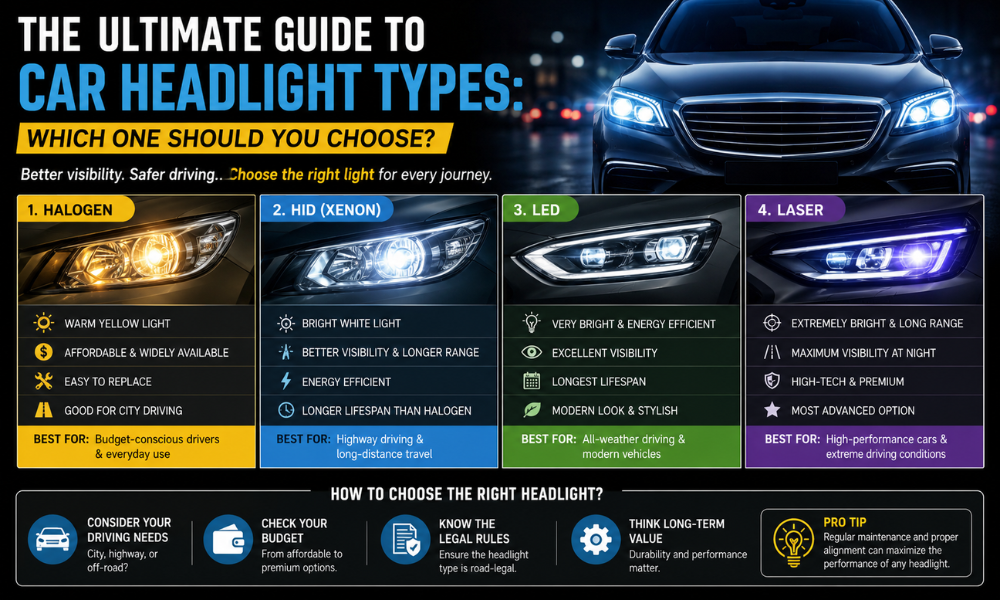
Driving at night or in poor weather conditions depends heavily on one essential component of your vehicle—the headlights. Modern automotive lighting has evolved significantly over the years, offering drivers better visibility, improved safety, and greater energy efficiency. Today, car owners can choose from four main types of headlights: Halogen, HID (Xenon), LED, and Laser.
Each technology has its own advantages, disadvantages, lifespan, brightness, and cost. Understanding these differences will help you make an informed decision when replacing or upgrading your vehicle’s headlights.
Why Choosing the Right Headlight Matters
Headlights do much more than illuminate the road ahead. They improve visibility during nighttime driving, increase safety in fog, rain, and snow, and make your vehicle more visible to other drivers.
The right headlight can:
- Improve reaction time while driving
- Reduce eye strain during long night journeys
- Increase road safety
- Enhance your car’s appearance
- Lower maintenance costs through longer lifespan
Let’s explore each type of headlight in detail.
-
Halogen Headlights
Halogen headlights have been the industry standard for decades and are still found in many budget-friendly vehicles.
How They Work
A halogen bulb contains a tungsten filament enclosed inside a glass capsule filled with halogen gas. When electricity passes through the filament, it glows and produces light.
Advantages
- Most affordable option
- Easy to replace
- Widely available
- Compatible with almost every vehicle
- Low replacement cost
Disadvantages
- Lower brightness than newer technologies
- Yellowish light output
- Generates more heat
- Higher energy consumption
- Shorter lifespan
Typical Beam Distance
Approximately 150 meters
Average Lifespan
500–1,000 hours
Best For
- Daily city driving
- Budget-conscious drivers
- Older vehicles
-
HID (Xenon) Headlights
High-Intensity Discharge (HID), commonly known as Xenon headlights, became popular in luxury cars during the early 2000s.
Unlike halogen bulbs, HID lights produce illumination through an electrical arc between two electrodes inside xenon gas.
Advantages
- Much brighter than halogen
- White or bluish-white light
- Longer beam distance
- Better visibility on highways
- Lower energy consumption than halogen
Disadvantages
- Higher installation cost
- Requires a ballast for operation
- Can produce glare if not properly aligned
- Replacement is more expensive
Typical Beam Distance
Around 200 meters
Average Lifespan
Approximately 2,000–3,000 hours
Best For
- Highway driving
- Drivers needing longer visibility
- Premium vehicles
-
LED Headlights
LED (Light Emitting Diode) technology has become the preferred choice for most modern vehicles due to its outstanding efficiency and performance.
Instead of using filaments or gas, LEDs generate light using semiconductor technology.
Advantages
- Bright white light
- Excellent energy efficiency
- Long lifespan
- Quick illumination
- Minimal heat generation
- Compact design
- Modern appearance
Disadvantages
- Higher initial cost
- Quality varies among manufacturers
- Some vehicles require compatible housings
Typical Beam Distance
Approximately 300 meters
Average Lifespan
10,000–30,000 hours
Best For
- Daily driving
- Long-distance travel
- Modern vehicles
- Drivers seeking low maintenance
-
Laser Headlights
Laser headlights represent the newest generation of automotive lighting technology.
Despite the name, laser headlights do not project laser beams directly onto the road. Instead, lasers excite phosphor material inside the headlight, creating an extremely bright white light.
Advantages
- Longest illumination range
- Highest brightness
- Extremely energy efficient
- Compact size
- Advanced technology
- Premium appearance
Disadvantages
- Most expensive option
- Limited availability
- Mainly found in luxury vehicles
- High repair costs
Typical Beam Distance
Up to 600 meters
Average Lifespan
Often exceeds 30,000 hours
Best For
- Premium cars
- High-speed highway driving
- Drivers demanding maximum visibility
Comparison of Car Headlight Types
| Feature | Halogen | HID (Xenon) | LED | Laser |
| Brightness | Low | High | Very High | Excellent |
| Beam Distance | 150 m | 200 m | 300 m | 600 m |
| Lifespan | 500–1,000 hrs | 2,000–3,000 hrs | 10,000–30,000 hrs | 30,000+ hrs |
| Energy Efficiency | Low | Medium | High | Very High |
| Heat Generation | High | Medium | Low | Very Low |
| Replacement Cost | Low | Medium | High | Very High |
| Technology | Traditional | Advanced | Modern | Premium |
Can You Upgrade from Halogen to LED?
Yes, many vehicle owners upgrade from halogen to LED headlights because they provide:
- Brighter illumination
- Better road visibility
- Longer lifespan
- Lower power consumption
- Improved driving safety
- Modern styling
However, before upgrading, ensure that:
- The LED bulb matches your vehicle’s socket type.
- The headlight housing supports LED technology.
- The beam pattern remains correctly aligned.
- The upgrade complies with your country’s road regulations.
Poorly installed LED bulbs can create excessive glare for oncoming drivers.
Which Headlight Is Best for You?
The ideal choice depends on your budget, driving habits, and vehicle type.
Choose Halogen if:
- You want the most affordable replacement.
- You drive mainly in well-lit urban areas.
- You own an older vehicle.
Choose HID if:
- You frequently drive on highways.
- You need a brighter and longer beam.
- You prefer premium lighting without the cost of laser systems.
Choose LED if:
- You want the best balance of brightness, efficiency, and lifespan.
- You drive regularly at night.
- You want lower maintenance costs over time.
Choose Laser if:
- Budget is not a concern.
- You own a luxury vehicle.
- You want the latest lighting technology and maximum visibility.
Tips for Better Headlight Performance
Even the best headlights require proper maintenance. Follow these tips to ensure optimal performance:
- Clean headlight lenses regularly.
- Replace bulbs in pairs for consistent brightness.
- Check headlight alignment periodically.
- Avoid touching bulb glass with bare hands during installation.
- Inspect wiring and connectors for corrosion.
- Polish cloudy or oxidized headlight covers.
- Use headlights appropriately in fog, rain, and low-light conditions.
Are Brighter Headlights Always Better?
Not necessarily. While brighter headlights improve your visibility, improperly installed or excessively bright lights can create glare for other road users. Modern LED and laser systems are designed with advanced optics and adaptive beam technology to maximize visibility while minimizing glare.
Always choose headlights that meet your local automotive safety standards and ensure they are professionally installed if required.
Final Thoughts
Choosing the right car headlight is about balancing performance, safety, longevity, and cost. Halogen headlights remain an economical option for basic driving needs, while HID headlights offer stronger illumination for highway travel. LED headlights have become the preferred choice for most drivers thanks to their exceptional brightness, energy efficiency, and long lifespan. Laser headlights deliver unmatched performance but are generally reserved for premium vehicles due to their high cost.
For the majority of drivers, LED headlights provide the best overall value, combining superior visibility, durability, and low energy consumption. However, the right choice ultimately depends on your vehicle, driving conditions, and budget. Investing in quality headlights and maintaining them properly will ensure safer, more comfortable driving—especially during nighttime and adverse weather conditions.