
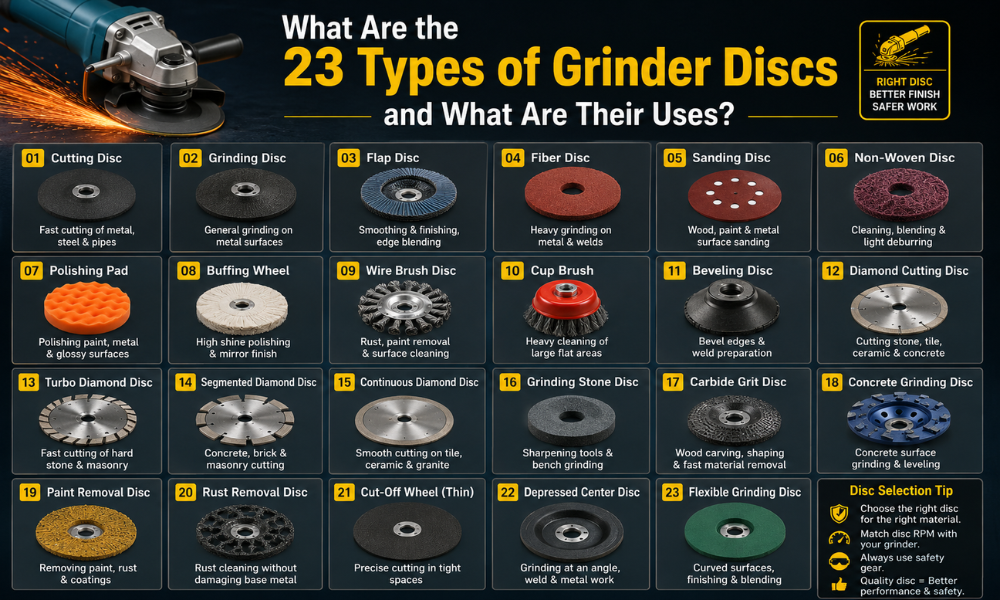
An angle grinder is one of the most versatile power tools used in workshops, construction sites, fabrication units, garages, and industrial applications. However, the performance of a grinder depends greatly on selecting the right disc for the job. Different grinder discs are designed for specific tasks such as cutting, grinding, polishing, cleaning, sharpening, removing rust, or working with different materials.
Using the wrong disc can lead to poor results, damage to the workpiece, or even create a safety risk. That is why understanding the different types of grinder discs and their applications is important for professionals as well as DIY users.
There are many types of discs available, each with a different design, abrasive material, thickness, and purpose. Here are 23 commonly used grinder discs and their uses.
- Cut-Off or Cutting Disc
Cut-off discs are thin abrasive wheels designed primarily for cutting materials. They are commonly used to cut metals such as steel, stainless steel, iron, pipes, rods, and sheet metal. Their thin design allows for quick and precise cuts with minimal material loss. Cutting discs should always be used with the correct grinder and should not be used for side grinding.
- Grinding Disc
Grinding discs are thicker and stronger than cutting discs. They are designed to remove excess material and smooth rough metal surfaces. These discs are useful for grinding welds, shaping metal edges, removing burrs, and preparing surfaces for further work. They are widely used in fabrication and metalworking applications.
- Flap Disc
A flap disc consists of multiple overlapping abrasive flaps attached to a backing plate. It is commonly used for grinding, blending, deburring, and surface finishing. Flap discs provide a smoother finish compared with traditional grinding wheels and are available in different abrasive grits for different levels of material removal.
- Fiber Disc
Fiber discs are abrasive discs mounted on a strong fiber backing. They are commonly used for heavy-duty grinding, weld removal, stock removal, and surface preparation. Fiber discs are often used with a suitable backing pad and are popular in metal fabrication because they can remove material efficiently.
- Sanding Disc
Sanding discs are designed for surface smoothing and finishing. They can be used on materials such as wood, metal, and some other surfaces, depending on the abrasive type. Different grit levels allow users to choose between aggressive material removal and fine finishing.
- Non-Woven Surface Conditioning Disc
Non-woven discs are made from an abrasive fiber material and are mainly used for cleaning, light finishing, blending, and surface conditioning. They can help remove light rust, oxidation, paint residue, and surface imperfections without aggressively removing the base material.
- Polishing Pad
Polishing pads are used to create a smooth and shiny finish on suitable surfaces. They are commonly used for polishing metal, paintwork, and other compatible materials. Depending on the pad material and polishing compound, they can be used for light polishing or achieving a high-gloss finish.
- Felt Polishing Wheel
Felt polishing wheels are designed for fine polishing applications. When used with an appropriate polishing compound, they can produce a smooth and reflective finish on metals and other suitable surfaces. They are particularly useful during the final stages of polishing.
- Wire Wheel Brush
A wire wheel brush consists of metal wires arranged around a circular wheel. It is useful for removing rust, loose paint, dirt, scale, and other unwanted surface materials. Wire wheels are commonly used for surface preparation before painting, welding, or coating.
- Wire Cup Brush
Wire cup brushes have wire bristles arranged in a cup-shaped design. They are useful for cleaning large surfaces and removing rust, paint, scale, and corrosion. Their shape makes them suitable for working on broad areas and uneven surfaces.
- Wire End Brush
Wire end brushes are smaller brushes designed for cleaning difficult-to-reach areas. They are useful for removing rust, paint, dirt, and debris from corners, grooves, holes, and narrow spaces. Their compact design allows for more targeted cleaning compared with larger wire brushes.
- Diamond Cutting Blade
Diamond cutting blades contain diamond segments or a diamond-coated edge that provides excellent cutting performance on hard materials. Depending on the blade design, they can be used for cutting materials such as concrete, masonry, tiles, stone, and other hard surfaces. The correct blade should always be selected for the specific material.
- Diamond Continuous Rim Blade
A continuous rim diamond blade has a continuous diamond edge and is designed to provide cleaner and more precise cuts in suitable hard materials. It is often used for applications where a smoother cutting edge is important, such as cutting certain types of tile and similar materials.
- Turbo Diamond Blade
Turbo diamond blades feature a segmented or serrated cutting edge that helps provide a balance between cutting speed and finish. They are commonly used for cutting materials such as concrete, masonry, stone, and tiles. Their design helps improve cutting efficiency while maintaining reasonable control.
- Diamond Cup Wheel
Diamond cup wheels are used primarily for grinding and surface preparation on hard materials. They are commonly used on concrete, stone, masonry, and similar surfaces. They can help remove surface imperfections, level uneven areas, and prepare surfaces for further finishing.
- Carbide or Tungsten Carbide Disc
Carbide discs are designed for specialized material removal applications. They may be used for shaping or removing material from suitable surfaces, depending on their construction and manufacturer specifications. Their hard cutting surface makes them useful for demanding applications, but users should always follow the disc’s intended purpose.
- Chain Disc
Chain discs feature a chain-style cutting arrangement and are designed for specific cutting and shaping applications. They may be used for certain wood-related tasks, depending on the product design. Because these discs can be particularly aggressive, they require careful handling, proper compatibility with the grinder, and strict adherence to safety instructions.
- Rubber Backing Pad
A rubber backing pad is used to support certain sanding, polishing, or abrasive discs. It provides a flexible base that allows the attached abrasive to work effectively on the surface. Backing pads are available in different sizes and designs, so compatibility with the grinder and disc is important.
- Mop or Cloth Buffing Wheel
Mop or cloth buffing wheels are commonly used for polishing and finishing applications. They can help create a smooth surface and improve the appearance of suitable metals. These wheels are often used with polishing compounds to achieve different levels of shine and surface quality.
- Resin-Bonded Grinding Wheel
Resin-bonded grinding wheels use abrasive particles held together with a resin bonding material. They are available in different specifications for grinding and sharpening applications. These wheels are commonly used where controlled material removal and a suitable surface finish are required.
- Diamond Grinding Wheel
Diamond grinding wheels are designed for grinding hard materials and specialized applications. They are commonly used for working on concrete, stone, ceramics, and other compatible materials. Their diamond abrasive surface provides strong wear resistance and efficient material removal.
- Rubber Backing Disc
Rubber backing discs provide support for certain abrasive or polishing accessories. They are useful when flexibility and controlled contact with the work surface are required. The right backing disc can help improve the performance of compatible sanding or polishing accessories.
- Clean-and-Strip Disc
Clean-and-strip discs are made from an open, non-woven abrasive material designed for removing paint, rust, coatings, and surface contaminants. They are useful when you want to clean a surface without aggressively removing large amounts of the underlying material. These discs are widely used for surface preparation and restoration work.
How Do You Choose the Right Grinder Disc?
Choosing the correct grinder disc depends on several factors. First, consider the material you are working on. Metal, stainless steel, concrete, stone, wood, and tiles may require completely different discs.
Next, identify the type of work you want to perform. Cutting requires a cutting disc, while heavy material removal may require a grinding disc. For surface finishing, a flap disc or sanding disc may be more appropriate. If the goal is rust or paint removal, a wire brush or clean-and-strip disc can be a better option.
You should also check the disc size, maximum RPM, and grinder compatibility before use. The disc must be rated for the speed of the grinder. Using an incompatible or damaged disc can be extremely dangerous.
Safety Tips When Using Grinder Discs
Safety should always be the first priority when operating an angle grinder. Always inspect the disc for cracks, damage, or excessive wear before use. Never use a disc that is damaged or unsuitable for the grinder.
Wear appropriate personal protective equipment, including safety goggles or a face shield, gloves, hearing protection, and suitable work clothing. Make sure the grinder’s guard is correctly installed and positioned. Secure the workpiece properly and maintain a stable grip while operating the tool.
Always follow the manufacturer’s instructions for both the grinder and the disc. Never exceed the maximum RPM rating of the disc, and use each disc only for its intended application.
Conclusion
The right grinder disc can make a significant difference in the quality, speed, and safety of your work. From cutting and grinding to polishing, cleaning, rust removal, and surface preparation, each disc has a specific purpose. Understanding the differences between these 23 types of grinder discs helps you select the appropriate accessory for your application.
Whether you are a professional fabricator, metalworker, mechanic, construction worker, or DIY enthusiast, choosing the correct disc is essential for achieving better results. Always consider the material, application, disc specifications, and safety requirements before starting your work. With the right grinder disc and proper technique, your angle grinder can become a highly effective tool for a wide range of projects.