
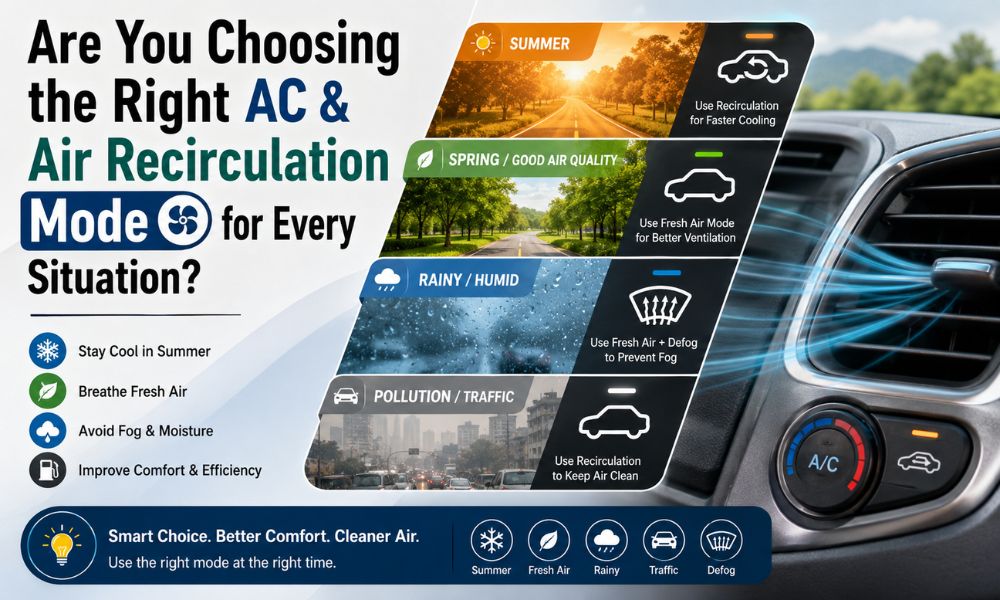
Your car’s air-conditioning system does more than simply make the cabin cool. The AC and air recirculation settings you choose can affect cooling speed, cabin comfort, visibility, air quality, and even how efficiently the system operates. Many drivers use the same setting every time they drive, but the ideal mode can change depending on whether you are driving in hot weather, winter, rain, heavy traffic, or on a highway.
Understanding the difference between Air Recirculation Mode and Fresh Air Mode can help you make better use of your car’s climate-control system. The recirculation button usually shows a car symbol with a curved arrow moving inside the cabin. When activated, the system mainly circulates air already inside the vehicle. Fresh Air Mode, on the other hand, allows outside air to enter the cabin.
So, are you choosing the right mode for every driving situation? Let’s understand when to use each setting.
What Is Air Recirculation Mode?
Air Recirculation Mode closes the outside-air intake and allows the AC system to circulate air that is already inside the cabin. Because the air has already been cooled, the AC system does not need to work as hard to cool hot outside air continuously.
This makes recirculation particularly useful when you want to cool the cabin quickly. For example, if your car has been parked under the sun, the interior may become extremely hot. Once you start driving, using Recirculation + AC after initially ventilating the cabin can help the cooling system bring the cabin temperature down more quickly.
Recirculation can also be helpful when driving through areas with unpleasant smells, smoke, dust, or temporary outdoor pollution. By limiting the amount of outside air entering the cabin, it can reduce the entry of these external irritants. However, it should not necessarily be used continuously for very long periods.
When Should You Use Recirculation Mode?
- During Hot Summer Weather
Summer is one of the best situations for using air recirculation. When the outside temperature is high, bringing hot outdoor air into the cabin continuously increases the cooling load on the AC system.
For faster cooling, you can follow this general approach:
- Open the windows briefly when entering a very hot car.
- Allow some of the trapped hot air to escape.
- Turn on the AC.
- Select Recirculation Mode once the initial hot air has been vented.
- Adjust the fan and temperature according to your comfort.
Using recirculation after ventilating the vehicle helps the AC focus on cooling the cabin air rather than repeatedly cooling hot air from outside.
- In Heavy Traffic or Traffic Jams
Traffic congestion can expose drivers and passengers to exhaust fumes, smoke, and unpleasant odors from surrounding vehicles. In such conditions, Recirculation Mode can be a practical choice.
Keeping recirculation ON temporarily can reduce the amount of outside air entering the cabin. However, if you remain in recirculation mode for a very long time with several occupants inside, the cabin air can become stale and carbon dioxide levels can rise.
For this reason, it is sensible to switch to Fresh Air Mode periodically, especially when traffic conditions improve.
- When Driving Through Dusty or Polluted Areas
If you are passing through a dusty road, construction zone, smoky area, or a location with strong odors, recirculation can help limit the entry of outside air.
However, remember that recirculation does not make the cabin completely isolated from outside pollution. Air can still enter through door seals and other openings, and the effectiveness of filtration depends on the vehicle’s cabin air filter and HVAC system.
Regular replacement of the cabin air filter is therefore important for maintaining good interior air quality.
When Should You Use Fresh Air Mode?
Fresh Air Mode allows outside air to enter the vehicle through the HVAC system. It is useful when you want to refresh the cabin and prevent the interior from feeling stuffy.
- During Long Highway Drives
On longer journeys, especially with multiple passengers, periodically bringing in fresh outside air can improve cabin comfort. Continuous recirculation may make the interior feel stale over time.
A practical approach is to use recirculation when you need faster cooling and switch to fresh air periodically when conditions outside are clean and comfortable.
However, if you are driving through an area with heavy pollution, smoke, or dust, you may prefer recirculation temporarily.
- When You Need Better Cabin Air Circulation
If the cabin starts feeling stuffy or uncomfortable, switching to Fresh Air Mode can help introduce outside air. This is particularly useful when several people are traveling together.
There is no universal fixed time interval that every car should follow. The right choice depends on the number of passengers, outside air quality, vehicle design, weather, and personal comfort.
- When You Want to Remove Unpleasant Interior Odors
If there is an odor inside the vehicle, Fresh Air Mode can help ventilate the cabin when outside air is cleaner than the air inside. Opening the windows for a short period can also help exchange cabin air.
However, persistent smells should not simply be covered up by changing AC modes. They may indicate a dirty cabin filter, moisture accumulation, mold growth, or another maintenance issue.
What About Winter and Windshield Fogging?
Winter driving requires a different approach. When the windshield begins to fog, the priority should be clear visibility.
Using the defog or defrost setting directs airflow toward the windshield. Depending on the vehicle, the AC compressor may also operate in defogging mode because air conditioning helps remove moisture from the air.
In many situations, using Fresh Air Mode with the defog/defrost setting is more appropriate than continuously recirculating humid cabin air. If the cabin contains moisture from passengers, wet clothes, or rain, continuously recirculating that air may contribute to fogging.
The exact controls vary between vehicles, so drivers should follow the instructions in their owner’s manual.
What Should You Use on Rainy Days?
Rainy weather often creates higher humidity around and inside the vehicle. If the windows begin to mist or fog, using the AC with the appropriate defog or defrost setting can help improve visibility.
A common approach is:
Fresh Air + AC + Defog/Defrost when required
The AC system can help dehumidify the air, while the airflow directed toward the windshield helps clear condensation. If visibility is reduced, always prioritize clearing the windshield before continuing to drive.
What About a Car Parked Under the Sun?
A vehicle parked in direct sunlight can become significantly hotter than the surrounding outdoor temperature. When you first enter the vehicle, the cabin may contain trapped hot air.
Instead of immediately keeping the windows closed and relying only on recirculation, it can be helpful to briefly ventilate the cabin by opening the windows or doors when safe to do so. Once the accumulated hot air has escaped, switching to AC + Recirculation can help cool the interior more efficiently.
Once the desired temperature is reached, the system can be adjusted according to outside conditions and passenger comfort.
Does Recirculation Save Fuel?
Recirculation can potentially reduce the cooling workload because the AC system is repeatedly cooling air that has already been cooled rather than continuously drawing in hot outside air. This may help reduce the energy required by the HVAC system.
However, the actual effect on fuel consumption varies considerably depending on the vehicle, engine, compressor, outside temperature, humidity, driving speed, and AC settings. Therefore, it is not accurate to promise a specific percentage of fuel savings simply by using recirculation.
The best practice is to use the mode that provides the required comfort without unnecessarily running the AC at maximum settings.
A Simple Guide for Everyday Driving
You can remember the following general rule:
- Hot Summer: AC + Recirculation
- Very Hot Car After Parking: Ventilate first, then AC + Recirculation
- Heavy Traffic or Smoke: Recirculation temporarily
- Dusty or Polluted Roads: Recirculation temporarily
- Highway Driving: Fresh Air periodically when outside air is clean
- Long Journeys: Switch between modes based on cabin comfort and outside air quality
- Rainy Weather: Fresh Air + AC; use Defog when windows mist
- Winter Fogging: Fresh Air + Defog/Defrost as needed
- Bad Odors Outside: Recirculation
- Stuffy Cabin: Fresh Air when outside conditions are suitable
Don’t Forget Your Cabin Air Filter
Your AC settings are only one part of maintaining good cabin air quality. The cabin air filter plays an important role in filtering dust, pollen, and other particles from the air entering the vehicle.
A clogged or dirty filter can reduce airflow and may affect HVAC performance. If you notice weak airflow, unusual odors, or reduced ventilation, the cabin filter should be inspected and replaced according to the vehicle manufacturer’s recommended maintenance schedule.
Final Thoughts
Choosing between AC Recirculation Mode and Fresh Air Mode is not about finding one setting that works all the time. The right choice depends on the weather, traffic, air quality, number of passengers, and the condition of your windshield.
Use Recirculation Mode when you need faster cooling or want to temporarily limit outside smoke, dust, and unpleasant odors. Use Fresh Air Mode when you need to refresh the cabin, especially when outside air is clean. During rain and winter conditions, use the appropriate AC and defog/defrost settings to help maintain clear visibility.
Most importantly, remember that clear visibility and safe driving should always come first. By understanding when to switch between recirculation and fresh air, you can make your car’s climate-control system work more effectively while maintaining a more comfortable cabin environment.