
A Fixed Deposit (FD) remains one of the most popular investment choices for people who want predictable returns with relatively low risk. Instead of keeping ₹1 lakh idle in a savings account, many investors prefer to lock the money for a fixed period and earn interest on it.
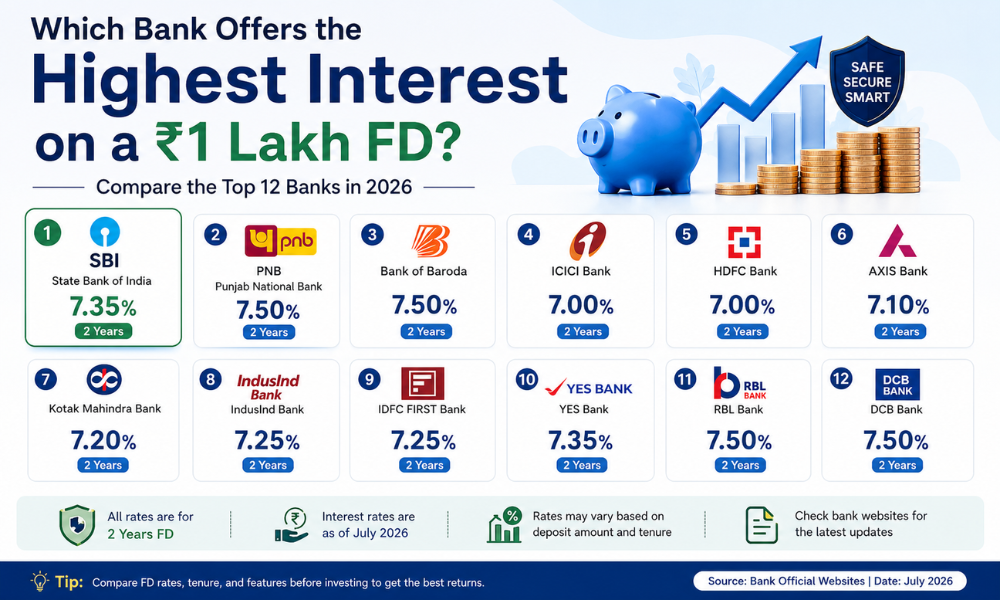
But choosing the right bank is important because FD interest rates vary from one bank to another and can also change based on the tenure, deposit type, and customer category. The image above compares 12 banks and their indicative FD interest rates for deposits with a tenure of around 1 to 2 years.
Based on the rates shown in the image, DCB Bank and RBL Bank offer the highest listed rate at 7.50% p.a., followed by YES Bank at 7.35%, while Kotak Mahindra Bank and IndusInd Bank are listed at 7.20% and 7.25%, respectively. However, investors should always verify the current rate on the bank’s official website before booking an FD because rates can change.
FD Interest Rates Compared: Top 12 Banks
The following comparison is based on the rates displayed in the provided image and is intended as a reference for regular customers for the indicated 1–2 year FD period.
- State Bank of India (SBI) – 6.80% p.a.
- Punjab National Bank (PNB) – 6.90% p.a.
- Bank of Baroda – 6.85% p.a.
- ICICI Bank – 7.00% p.a.
- HDFC Bank – 7.00% p.a.
- Axis Bank – 7.10% p.a.
- Kotak Mahindra Bank – 7.20% p.a.
- IndusInd Bank – 7.25% p.a.
- IDFC FIRST Bank – 7.25% p.a.
- YES Bank – 7.35% p.a.
- RBL Bank – 7.50% p.a.
- DCB Bank – 7.50% p.a.
According to the image, RBL Bank and DCB Bank are at the top of this particular comparison with a listed rate of 7.50% p.a. However, these figures should not automatically be treated as today’s guaranteed rates for every FD product. For example, banks publish different rates for different tenures and deposit categories, and some special FD products may have different conditions.
How Much Interest Can You Earn on a ₹1 Lakh FD?
Suppose you invest ₹1 lakh in an FD. The actual interest you receive depends on the interest rate, tenure, compounding frequency, and whether you choose cumulative or non-cumulative interest.
For a simple illustration, if ₹1 lakh earns interest at 7.50% per year, the interest for one year would be approximately ₹7,500 before applicable taxes, assuming a simple annual calculation.
At 7.00%, the same simple calculation would give approximately ₹7,000 in one year.
At 6.80%, it would be approximately ₹6,800.
The actual maturity amount may be different because many bank FDs use quarterly compounding, particularly for cumulative deposits. Therefore, the final maturity value should be calculated using the bank’s FD calculator or the exact interest calculation method mentioned in the deposit terms.
For example, the difference between a 7.50% and 6.80% annual rate on ₹1 lakh is 0.70 percentage points. On a simple one-year basis, that difference is around ₹700 before tax. This shows that while the highest interest rate is attractive, the difference between banks may not always be large enough to be the only factor in your decision.
RBL Bank and DCB Bank: Highest Rates in the Image
The image lists RBL Bank and DCB Bank at 7.50% p.a., making them the highest among the 12 banks shown.
For an investor looking specifically for higher FD returns, these rates may appear attractive. However, it is essential to check the exact tenure and conditions applicable to the FD before investing.
Investors should also consider the bank’s deposit insurance coverage, premature withdrawal rules, minimum deposit requirements, payout options, and overall convenience. A slightly higher interest rate should not be the sole reason for choosing a particular bank.
YES Bank, IDFC FIRST Bank and IndusInd Bank
The image lists YES Bank at 7.35%, while IDFC FIRST Bank and IndusInd Bank are shown at 7.25%.
These banks may be considered by investors who want to compare private-sector banking options alongside traditional large banks. However, the exact FD rates available to customers can depend on the selected tenure and the date on which the deposit is booked.
When comparing FDs, investors should check whether the displayed rate applies to the exact period they want. A rate for 18 months, for example, may not be the same as the rate for 12 months or 24 months.
Kotak Mahindra Bank and Axis Bank
The image shows Kotak Mahindra Bank at 7.20% and Axis Bank at 7.10%.
Official bank rate pages should always be checked before making an investment decision. For example, Kotak’s published rate table shows that FD rates vary considerably by maturity period. Its retail FD rates effective June 10, 2026, included 6.35% for 365 days to less than 15 months and 6.55% for 18 months to less than 2 years, while the bank’s senior-citizen rates were higher for corresponding periods. This demonstrates why comparing only one headline percentage without checking the exact tenure can be misleading.
ICICI Bank and HDFC Bank
Both ICICI Bank and HDFC Bank are listed at 7.00% in the image.
Large private-sector banks such as these are often considered by investors who value digital banking facilities, established branch networks, and convenient online FD booking. However, investors should compare the exact applicable rate rather than relying solely on the rate shown in a social media graphic or comparison image.
The final rate can depend on the deposit tenure, customer category, and the bank’s current rate card.
SBI, PNB and Bank of Baroda
The image lists SBI at 6.80%, Bank of Baroda at 6.85%, and PNB at 6.90%.
These banks may appeal to investors who prefer large established public-sector banks. For many people, the choice between banks is not simply about the highest interest rate. Factors such as accessibility, existing banking relationships, digital services, and comfort with the institution can also influence the decision.
SBI, for instance, offers different term-deposit products, including non-callable term deposits with specific restrictions on premature withdrawal. Its official information states that one such product offers rates from 7.25% p.a. from April 1, 2026, subject to its terms and conditions, illustrating again that different FD products can have different rates from standard retail FDs.
What Should You Check Before Investing ₹1 Lakh in an FD?
Before opening an FD, don’t look at the interest rate alone. Consider these important factors:
- Check the Exact Tenure
A bank may offer different rates for 1 year, 15 months, 18 months, 2 years, and other periods. Always check the rate for your exact investment period.
- Compare Regular and Senior Citizen Rates
Senior citizens often receive an additional interest rate benefit, depending on the bank and product. If you qualify, compare the applicable senior-citizen rate separately.
- Understand Premature Withdrawal Rules
If you need to withdraw the FD before maturity, the bank may reduce the interest payable and apply a penalty. Some special FD products may not allow premature withdrawal at all.
- Consider Cumulative vs Non-Cumulative FD
A cumulative FD generally pays the accumulated interest along with the principal at maturity, while a non-cumulative FD can provide periodic interest payouts. Choose according to your cash-flow requirements.
- Check Tax and TDS Rules
FD interest is taxable according to applicable income-tax rules. Depending on your circumstances and the applicable threshold, the bank may deduct Tax Deducted at Source (TDS). Therefore, the interest rate displayed should not be confused with your final post-tax return.
- Verify Deposit Insurance
Eligible bank deposits are covered by deposit insurance subject to the applicable rules and limits. Investors should understand the coverage before placing substantial amounts with any one bank.
- Check the Latest Rate Before Booking
FD rates can change. The image provided is dated 22 July 2026, but the applicable rate at the time you actually open the FD may be different. For example, Kotak’s published rate information notes that rates are subject to change and depend on the applicable date of deposit.
Which Bank Is Best for a ₹1 Lakh FD?
There is no single best bank for every investor. Based purely on the rates shown in the provided comparison image, RBL Bank and DCB Bank rank highest at 7.50% p.a., making them the top options in that particular list.
However, if you are investing ₹1 lakh, the best choice should be based on a combination of interest rate, tenure, bank reliability, premature withdrawal flexibility, taxation, deposit insurance, and your personal financial goals.
It is also important to remember that a higher FD interest rate does not necessarily mean a better overall investment. Before opening an FD, compare the latest official rate cards of at least three or four banks and check the exact maturity amount you will receive.
Final Thoughts
A ₹1 lakh FD can be a simple way to earn predictable returns while keeping your investment relatively straightforward. The comparison in the provided image shows rates ranging from 6.80% to 7.50% p.a. among the 12 listed banks, with RBL Bank and DCB Bank appearing at the top at 7.50% p.a.
Still, investors should treat the image as a comparison reference rather than a guaranteed current rate card. FD rates change regularly, and the applicable rate can vary by tenure, customer type, and product category.
Before investing your ₹1 lakh, check the bank’s official website, confirm the latest interest rate, calculate the expected maturity amount, understand the tax implications, and review premature withdrawal conditions. A few minutes of comparison can help you choose an FD that better matches your financial goals and investment horizon.
Note: The interest rates mentioned in the comparison section are based on the user-provided image dated 22 July 2026. Bank FD rates are subject to change. Always verify the latest rate and terms directly with the respective bank before making an investment.