
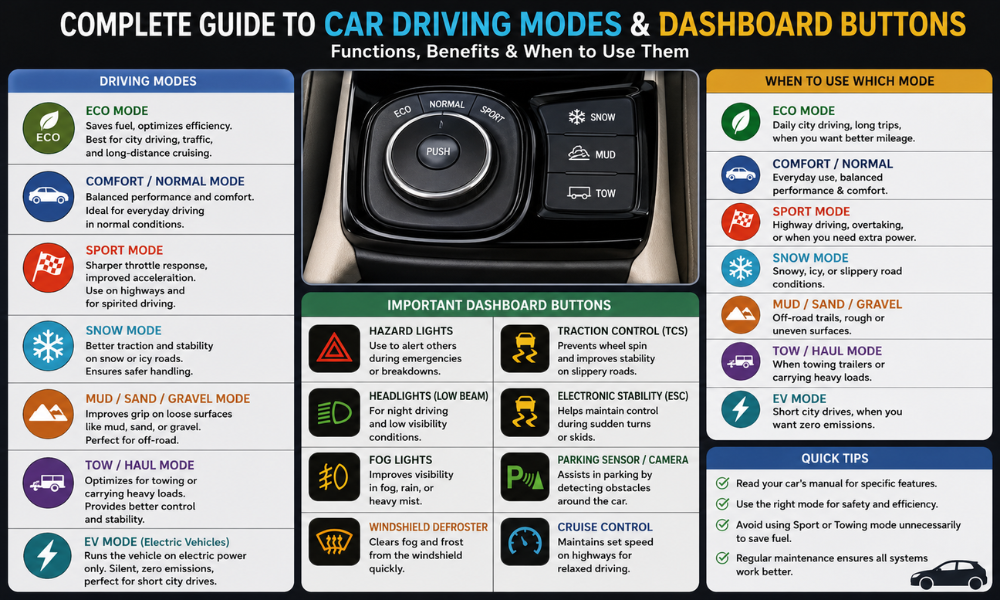
Modern cars are equipped with advanced driving modes and intelligent dashboard buttons that enhance safety, comfort, fuel efficiency, and overall driving performance. While many drivers use these buttons daily, only a few understand their actual purpose and the situations in which they should be used. Selecting the right driving mode not only improves vehicle performance but also helps protect the engine, transmission, and tires while making every journey safer.
Whether you drive a hatchback, sedan, SUV, hybrid, electric vehicle, or 4×4, understanding these features can make you a smarter and more confident driver. This guide explains the most common driving modes and dashboard buttons found in modern vehicles, along with their benefits and ideal usage.
-
ECO Mode
Purpose: Improve fuel efficiency.
ECO Mode adjusts the engine and transmission settings to reduce fuel consumption. It softens throttle response, optimizes gear shifting, and limits unnecessary power output, allowing the vehicle to consume less fuel during daily driving.
Benefits
- Increases fuel economy.
- Reduces engine load.
- Smooth and comfortable acceleration.
- Environment-friendly by lowering emissions.
Best Time to Use
- City driving.
- Daily office commutes.
- Heavy traffic.
- Long-distance highway cruising where rapid acceleration is not required.
Avoid using ECO Mode when quick acceleration is necessary, such as overtaking another vehicle.
-
Normal Mode
Purpose: Balanced everyday driving.
Normal Mode provides an ideal balance between fuel efficiency and performance. The vehicle responds naturally without prioritizing either economy or power.
Benefits
- Comfortable driving experience.
- Balanced throttle response.
- Suitable for most road conditions.
- Consistent engine performance.
Best Time to Use
- Daily driving.
- Mixed city and highway travel.
- General family use.
-
Sport Mode
Purpose: Maximum driving performance.
Sport Mode increases engine responsiveness and keeps the transmission in lower gears longer, allowing faster acceleration and more power.
Benefits
- Quicker throttle response.
- Faster gear shifts.
- Higher engine RPM.
- Better overtaking capability.
- More engaging driving experience.
Best Time to Use
- Highways.
- Mountain roads.
- Performance driving.
- Situations requiring quick acceleration.
Since Sport Mode increases fuel consumption, it is not recommended for everyday commuting.
-
Snow Mode
Purpose: Improve traction on slippery roads.
Snow Mode reduces wheel spin by limiting engine torque and providing smoother acceleration.
Benefits
- Better grip on snow and ice.
- Improved vehicle stability.
- Reduced chances of skidding.
- Safer winter driving.
Best Time to Use
- Snow-covered roads.
- Icy roads.
- Wet and slippery surfaces.
-
Mud/Sand Mode
Purpose: Off-road traction.
Mud/Sand Mode changes the traction control system and throttle response to improve performance on loose surfaces.
Benefits
- Better wheel traction.
- Reduced wheel slipping.
- Improved off-road capability.
- Enhanced control on uneven terrain.
Best Time to Use
- Sandy roads.
- Muddy trails.
- Desert driving.
- Off-road adventures.
Avoid using this mode on normal paved roads.
-
Tow/Haul Mode
Purpose: Carrying heavy loads.
Tow/Haul Mode modifies transmission behavior to improve stability while towing trailers or transporting heavy cargo.
Benefits
- Better engine braking.
- Reduced transmission stress.
- Improved towing stability.
- Enhanced control on slopes.
Best Time to Use
- Pulling trailers.
- Carrying heavy luggage.
- Caravan towing.
- Mountain driving with heavy loads.
-
EV Mode (Hybrid Vehicles)
Purpose: Battery-only driving.
Available in hybrid vehicles, EV Mode allows the vehicle to operate solely on electric power for short distances.
Benefits
- Zero fuel consumption during EV operation.
- Quiet driving.
- Lower emissions.
- Reduced engine wear.
Best Time to Use
- Traffic jams.
- Residential areas.
- Parking lots.
- Short-distance travel at low speeds.
-
Auto Mode
Purpose: Intelligent automatic adjustment.
Auto Mode uses sensors and the vehicle’s electronic control system (ECU) to automatically select the most suitable driving settings according to road conditions.
Benefits
- Convenient driving.
- Automatic optimization.
- Improved efficiency.
- Balanced performance.
Best Time to Use
- Mixed driving conditions.
- Variable weather.
- Everyday driving.
Important Dashboard Buttons
Besides driving modes, modern vehicles include several dashboard buttons that improve comfort and safety.
-
Auto Hold
Auto Hold keeps the vehicle stationary after you stop, even when you remove your foot from the brake pedal.
Benefits
- Reduces driver fatigue.
- Convenient during traffic jams.
- Prevents rolling on slopes.
- Easier stop-and-go driving.
Best Time to Use
- Heavy traffic.
- Traffic signals.
- Inclined roads.
- Urban driving.
-
HOLD Button (Automatic Transmission)
The HOLD function allows the automatic transmission to start in a higher gear, reducing wheel spin on slippery surfaces.
Benefits
- Better traction.
- Smooth starts.
- Less wheel slip.
- Improved stability.
Best Time to Use
- Wet roads.
- Snow.
- Ice.
- Slippery conditions.
-
Hill Descent Control (HDC)
Hill Descent Control automatically manages braking while driving downhill, allowing the driver to focus on steering.
Benefits
- Safe downhill driving.
- Prevents excessive speed.
- Better vehicle control.
- Reduced driver stress.
Best Time to Use
- Mountain roads.
- Steep descents.
- Off-road terrain.
-
Downhill Assist Control (DAC)
DAC performs a similar function to HDC by controlling vehicle speed during steep downhill driving without requiring constant brake input.
Benefits
- Controlled descent.
- Improved safety.
- Better traction.
- Easier off-road driving.
Best Time to Use
- Rocky roads.
- Steep hills.
- Off-road trails.
-
Crawl Control (4×4)
Found mainly in SUVs and off-road vehicles, Crawl Control automatically manages acceleration and braking at very low speeds.
Benefits
- Better off-road capability.
- Improved traction.
- Less driver effort.
- Safer obstacle navigation.
Best Time to Use
- Rock crawling.
- Deep mud.
- Sand dunes.
- Challenging off-road routes.
-
TRAC OFF / TCS OFF
This button disables the Traction Control System, allowing wheels to spin freely when necessary.
Benefits
- Helps free a stuck vehicle.
- Useful in deep mud or sand.
- Improves recovery in certain off-road situations.
Best Time to Use
- Deep snow.
- Mud.
- Sand.
- Off-road recovery.
Do not leave Traction Control OFF during normal road driving, as it reduces vehicle stability.
-
VSC OFF / ESP OFF
Vehicle Stability Control (VSC) or Electronic Stability Program (ESP) helps maintain vehicle stability during sudden steering or slippery conditions. Turning it off disables these electronic safety systems.
Benefits
- Useful during specific off-road conditions.
- Allows greater wheel movement.
- Helps in specialized driving situations.
Best Time to Use
- Off-road driving.
- Vehicle recovery.
- Professional driving environments.
For everyday road use, VSC/ESP should remain ON to maximize safety.
Tips for Using Driving Modes Correctly
- Always choose the driving mode according to road and weather conditions.
- Read your vehicle owner’s manual to understand available features.
- Do not switch off safety systems unless absolutely necessary.
- Use Sport Mode only when extra performance is required.
- Activate ECO Mode for daily commuting to save fuel.
- Use Auto Hold in heavy traffic for greater comfort.
- Engage Snow or Mud Mode only when driving on appropriate surfaces.
- Keep electronic safety systems enabled during regular driving.
Conclusion
Today’s vehicles are designed with intelligent technology to improve every aspect of driving. Features like ECO Mode, Sport Mode, Snow Mode, Mud/Sand Mode, Tow/Haul Mode, EV Mode, Auto Hold, Hill Descent Control, Crawl Control, Traction Control, and Stability Control are more than just buttons on the dashboard—they are advanced systems engineered to enhance safety, efficiency, and driving confidence.
Understanding when and how to use each driving mode allows you to maximize fuel economy, enjoy better vehicle performance, reduce wear on critical components, and stay safer in changing road conditions. By using these features correctly, every journey becomes smoother, more efficient, and more enjoyable, whether you’re commuting through city traffic, exploring off-road trails, towing heavy loads, or driving in challenging weather.