
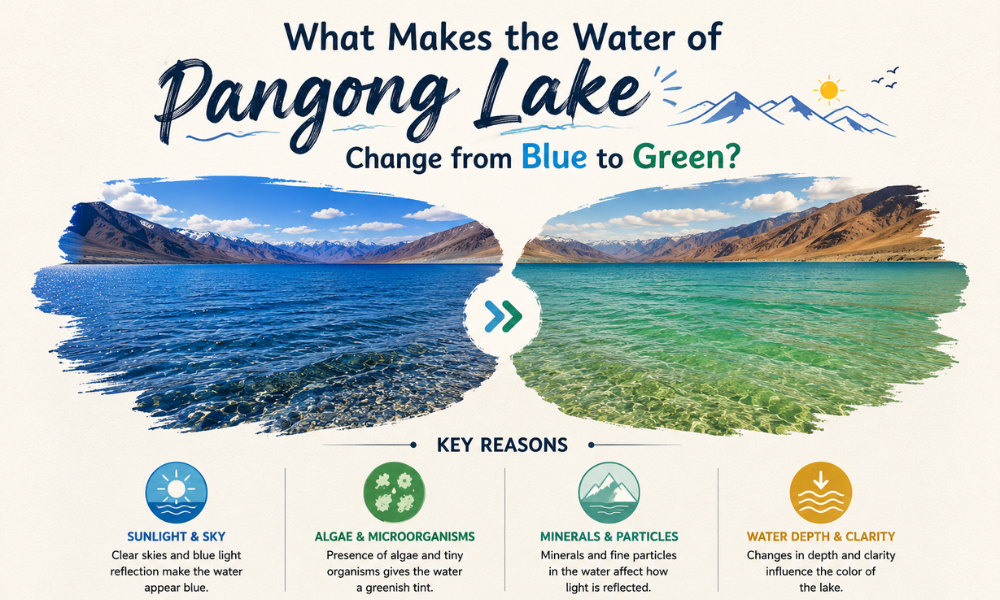
Nestled at an altitude of around 4,350 meters (14,270 feet) in the breathtaking landscape of Ladakh, Pangong Lake is one of India’s most extraordinary natural attractions. Stretching for approximately 134 kilometers, this high-altitude lake is internationally recognized not only for its stunning beauty but also for its fascinating ability to change colors throughout the day. Visitors often arrive expecting to see a deep blue lake, only to witness shades of turquoise, emerald green, and even steel grey as the sunlight shifts.
This remarkable phenomenon has made Pangong Lake one of the most photographed destinations in India. But what actually causes the water to transform from blue to green? Is it a mystery of nature, or is there a scientific explanation?
Let’s explore the fascinating reasons behind Pangong Lake’s ever-changing colors.
A Lake Shared Between India and China
Pangong Lake is a unique endorheic (landlocked) lake situated in the Himalayas. Around one-third of the lake lies in India, while the remaining portion extends into the Tibet Autonomous Region of China. Unlike freshwater lakes, Pangong Lake contains saline water, making it unsuitable for drinking despite its crystal-clear appearance.
Its surrounding landscape features towering mountains, rocky terrain, and virtually no dense vegetation. These natural surroundings play a significant role in the lake’s changing appearance.
Why Does Pangong Lake Change Colors?
The changing colors of Pangong Lake are not caused by artificial factors or pollution. Instead, they are the result of several natural elements working together.
- Reflection of Sunlight
The primary reason behind the changing colors is sunlight.
Sunlight consists of multiple colors, each having different wavelengths. When sunlight strikes the surface of the lake, some wavelengths are absorbed while others are reflected. Depending on the angle of the sun during sunrise, midday, or sunset, different colors become more visible.
During the morning, the lake often appears soft blue. By afternoon, brighter turquoise shades emerge. Towards evening, the water may display greenish or even golden reflections.
This continuous movement of sunlight creates an ever-changing visual experience.
- Crystal-Clear Water
One of Pangong Lake’s greatest natural advantages is its exceptional water clarity.
Because the lake contains relatively little suspended sediment compared to many lowland lakes, sunlight can penetrate deeper into the water. This enhances the scattering of blue and green wavelengths, making the lake appear vibrant and transparent.
The cleaner the water, the more dramatic the color variations become.
- Mineral Composition
Pangong Lake contains dissolved minerals and salts accumulated over thousands of years.
These naturally occurring minerals interact with incoming sunlight, subtly influencing the lake’s appearance. Although minerals alone do not create dramatic color changes, they contribute to the lake’s turquoise and emerald shades under favorable lighting conditions.
Since Pangong Lake has no outlet river, minerals remain trapped within the lake, gradually increasing its salinity.
- The Lake’s Depth
Another important factor is the varying depth of the lake.
Some sections are relatively shallow, while others are considerably deeper.
- Deep water absorbs more light and usually appears dark blue.
- Shallow areas reflect the lakebed more easily, producing lighter shades such as turquoise or green.
As visitors travel along different viewpoints around Pangong Lake, they often notice completely different colors in each section.
- The Color of the Lakebed
The lakebed beneath Pangong Lake is composed of rocks, sand, gravel, and mineral deposits.
Where the water is shallow and exceptionally clear, sunlight reaches the bottom and reflects back. Depending on the color of the underlying rocks and sediments, the reflected light can produce greenish or turquoise hues.
This is why some parts of the shoreline appear emerald green while deeper areas remain deep blue.
- Weather Conditions
Weather has a surprisingly strong influence on Pangong Lake’s appearance.
On a bright, sunny day, the lake displays vivid blues and greens. During cloudy weather, the colors become softer, often shifting to grey or silver.
Rain, snowfall, and passing clouds constantly alter the intensity of sunlight, changing the lake’s appearance within minutes.
Many photographers visit the lake several times during the day because no two moments look exactly the same.
- Surrounding Mountains
The rugged Himalayan mountains surrounding Pangong Lake also contribute to its magical appearance.
Snow-covered peaks reflect bright sunlight, while darker rocky cliffs create contrasting shadows.
As the position of the sun changes, these mountains cast varying reflections onto the lake’s surface, adding another layer of color variation.
The combination of blue skies, white clouds, brown mountains, and crystal-clear water creates an ever-changing natural masterpiece.
Why Does the Water Sometimes Look Green?
Many visitors wonder why a lake famous for its blue color suddenly appears green.
Several natural factors combine to create this effect:
- Sunlight enters the shallow water.
- The sandy or rocky lakebed reflects light.
- Minerals in the water influence light scattering.
- The viewing angle changes.
- Reflections from surrounding hills and vegetation (where present) slightly alter the color.
The result is a stunning emerald or turquoise-green appearance that can last only a few minutes before changing again.
Best Time to Witness the Color Changes
The changing colors can be observed throughout the year, but the experience is especially memorable during the tourist season.
The best months to visit are generally from May to September, when roads are more accessible and the weather is relatively stable.
For the most dramatic color transitions:
- Early morning offers peaceful blue tones.
- Late morning showcases bright turquoise shades.
- Afternoon often brings vibrant green reflections.
- Sunset introduces golden, purple, and steel-blue hues.
Spending an entire day at the lake allows visitors to appreciate how dramatically the scenery evolves.
A Paradise for Photographers
Pangong Lake has become one of India’s most iconic photography destinations.
Professional photographers and travel enthusiasts are drawn to its changing colors because every image captures a unique moment. Even photographs taken from the same location just minutes apart can look completely different.
Using polarized lenses, different camera settings, and changing angles can reveal even more spectacular shades hidden within the water.
Is Climate Change Affecting Pangong Lake?
Like many fragile Himalayan ecosystems, Pangong Lake faces environmental challenges.
Rising temperatures, increasing tourism, plastic waste, and changing weather patterns may gradually affect the lake’s delicate ecological balance. While these factors do not directly cause the daily color changes, they can influence water quality and the surrounding environment over time.
Responsible tourism plays an important role in preserving this natural wonder. Visitors are encouraged to avoid littering, respect local wildlife, and minimize their environmental impact so future generations can continue to enjoy the lake’s beauty.
Final Thoughts
The mesmerizing transformation of Pangong Lake from deep blue to brilliant green is not a mystery but an extraordinary combination of science and nature. Sunlight, water clarity, mineral content, lake depth, the color of the lakebed, weather conditions, and the surrounding Himalayan landscape all work together to create one of the world’s most captivating natural displays.
Rather than maintaining a single shade, Pangong Lake constantly changes throughout the day, offering visitors a fresh and unforgettable view every time they look at it. This dynamic beauty is one of the reasons the lake remains a dream destination for travelers, photographers, and nature lovers from around the world.
Whether you visit at sunrise, under the bright afternoon sun, or during a peaceful sunset, Pangong Lake reminds us that nature is never truly still. Its shifting colors are a living masterpiece, making every visit a unique experience that leaves a lasting impression.