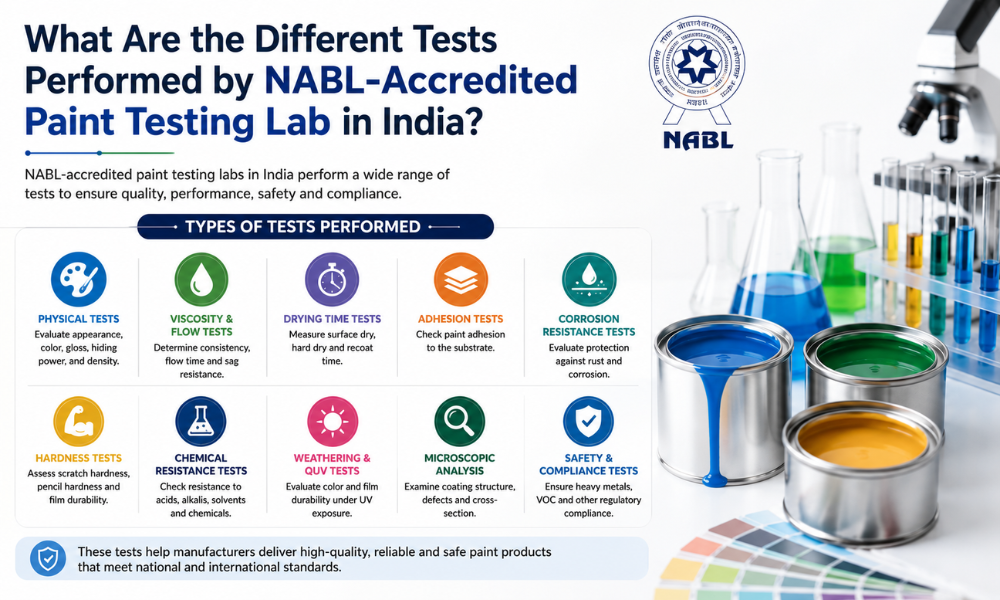
Paint is much more than a decorative finish. It protects metal, concrete, wood, and other surfaces from corrosion, weather damage, chemicals, moisture, and wear. Whether it is used in construction, automotive manufacturing, industrial equipment, pipelines, marine structures, or household products, the quality of paint directly affects durability and performance.
This is why manufacturers, contractors, exporters, and government organizations rely on NABL-accredited paint testing laboratories in India to verify that paints and coatings meet Indian and international quality standards. These laboratories perform a wide range of physical, chemical, mechanical, and performance tests using standardized methods such as IS, ASTM, ISO, and BIS specifications. NABL accreditation under ISO/IEC 17025 demonstrates that a laboratory has been assessed for technical competence in the specific tests it performs.
Let’s explore the different paint tests commonly performed by a NABL-accredited paint testing laboratory.
- Paint Adhesion Test
Adhesion is one of the most critical properties of any paint coating. This test measures how firmly the paint sticks to the substrate.
A Paint Testing Lab in India provides professional testing services to evaluate the quality, durability, performance, and compliance of paints and coatings using standardized methods, ensuring they meet Indian and international quality standards for various industrial and commercial applications.
Poor adhesion can result in peeling, blistering, or flaking, reducing the lifespan of the coating.
Common adhesion tests include:
- Cross Hatch Test
- Pull-Off Adhesion Test
- Tape Test
These tests are widely used for industrial equipment, automotive parts, pipelines, steel structures, and fabricated products.
- Dry Film Thickness (DFT) Test
The Dry Film Thickness Test determines the thickness of the cured paint layer after application.
If the coating is too thin, it may not provide sufficient protection. If it is too thick, cracking or poor curing may occur.
The DFT test helps ensure:
- Uniform coating
- Corrosion resistance
- Long coating life
- Compliance with project specifications
This is one of the most frequently requested paint inspection tests.
- Wet Film Thickness (WFT) Test
Before paint dries, inspectors measure the wet film thickness to verify that the required dry thickness will be achieved after curing.
This test helps reduce:
- Paint wastage
- Uneven coating
- Rework costs
- Application errors
- Coating Hardness Test
Once paint has fully cured, its hardness determines resistance against scratches, dents, and mechanical damage.
Common methods include:
- Pencil Hardness Test
- Barcol Hardness Test
- Shore Hardness Test
Hard coatings are especially important for machinery, automotive components, appliances, and industrial equipment.
- Impact Resistance Test
Industrial coatings often experience sudden mechanical impacts during transportation or operation. A NABL-accredited Paint Testing Laboratory in India performs standardized tests to ensure paints and coatings meet BIS, ASTM, ISO, and customer-specific quality requirements.
The Impact Resistance Test evaluates whether the coating cracks, chips, or separates from the surface after impact.
Industries using this test include:
- Automotive
- Engineering
- Oil & Gas
- Heavy Machinery
- Infrastructure
- Flexibility or Bend Test
Paint coatings must remain flexible even when the coated material bends during manufacturing or installation.
The Bend Test evaluates whether the coating can withstand deformation without cracking.
This test is commonly performed on:
- Metal sheets
- Aluminum panels
- Steel coils
- Industrial fabricated components
- Gloss Measurement Test
Gloss affects both appearance and product quality.
A Gloss Meter measures the amount of reflected light from the coated surface.
Paints are categorized as:
- High Gloss
- Semi Gloss
- Satin
- Matte
- Flat Finish
Consistent gloss is essential in automotive, decorative paints, furniture, and consumer products.
- Colour Matching Test
Colour consistency is essential for product branding and customer satisfaction.
Laboratories use advanced spectrophotometers to compare paint colour against approved standards.
This ensures:
- Batch consistency
- Accurate colour reproduction
- Customer approval
- Brand uniformity
- Salt Spray Test
One of the most important corrosion resistance tests is the Salt Spray Test.
Painted specimens are exposed to a controlled salt fog environment to evaluate long-term corrosion protection.
This test is commonly required for:
- Steel structures
- Marine coatings
- Automotive components
- Industrial equipment
- Fasteners
The longer the coating resists corrosion, the better its protective performance.
- Chemical Resistance Test
Paint coatings are often exposed to chemicals during service.
This test evaluates resistance against:
- Acids
- Alkalis
- Solvents
- Cleaning chemicals
- Industrial oils
- Fuels
Chemical-resistant coatings are essential in pharmaceutical, chemical, petrochemical, and food processing industries.
- Water Resistance Test
Many coatings are continuously exposed to water, humidity, or rain. Paint Testing Laboratories in India serve industries such as construction, automotive, marine, infrastructure, aerospace, and manufacturing with comprehensive coating evaluation services.
The Water Resistance Test checks whether prolonged water exposure causes:
- Blistering
- Softening
- Colour change
- Delamination
- Loss of adhesion
This test is particularly important for exterior paints and waterproof coatings.
- Weather Resistance Test
Outdoor coatings face harsh environmental conditions throughout the year.
Weather resistance testing evaluates paint performance against:
- UV radiation
- Heat
- Rain
- Humidity
- Temperature variations
Accelerated weathering chambers simulate years of outdoor exposure within a shorter testing period.
- Abrasion Resistance Test
Frequent rubbing, cleaning, or mechanical contact can damage paint.
The Abrasion Resistance Test measures how well the coating withstands repeated wear.
Industries requiring this test include:
- Flooring
- Industrial machinery
- Consumer appliances
- Automotive
- Furniture
- Holiday Detection Test
Holiday testing identifies tiny holes, pinholes, or discontinuities in protective coatings that are invisible to the naked eye.
Even a microscopic defect can allow moisture to reach the metal surface and initiate corrosion.
Holiday testing is widely performed for:
- Pipelines
- Storage tanks
- Offshore structures
- Industrial vessels
- Surface Profile and Coating Inspection
Before painting begins, inspectors evaluate the prepared surface.
Common inspection parameters include:
- Surface roughness
- Dust contamination
- Surface cleanliness
- Salt contamination
- Anchor profile
Proper surface preparation significantly improves coating adhesion and durability.
Why Choose a NABL-Accredited Paint Testing Laboratory?
Selecting a NABL-accredited laboratory provides confidence that testing is performed using validated methods, calibrated equipment, and qualified personnel. Accreditation is granted for specific testing scopes, so clients should verify that the required paint tests are included in the laboratory’s approved scope.
A trusted Paint Testing Lab in India performs advanced quality testing to improve product reliability, durability, and regulatory compliance.
Some major advantages include:
- Accurate and reliable test results
- Compliance with BIS, IS, ASTM, and ISO standards
- Acceptance by government departments and regulatory authorities
- Better quality control during manufacturing
- Improved product reliability
- Support for exports and certification
- Reduced product failures and warranty claims
Industries That Require Paint Testing
Paint testing laboratories serve a wide range of industries, including:
- Paint and coating manufacturers
- Construction companies
- Infrastructure projects
- Automotive manufacturers
- Railway sector
- Oil & Gas industry
- Marine and offshore engineering
- Aerospace
- Steel fabrication
- Electrical equipment manufacturers
- Consumer appliance manufacturers
Regular testing helps ensure coatings perform as expected under real-world conditions while meeting customer and regulatory requirements.
Conclusion
Paint quality directly influences the appearance, durability, and protection of countless products and structures. A NABL-accredited Paint Testing Lab in India performs comprehensive evaluations such as adhesion, coating thickness, hardness, impact resistance, flexibility, gloss, colour consistency, corrosion resistance, chemical resistance, weathering, abrasion, holiday detection, and surface inspection to verify coating performance.
Whether you are developing a new paint formulation, manufacturing coated products, executing infrastructure projects, or ensuring compliance with industry standards, partnering with a competent NABL-accredited laboratory provides dependable testing results. These evaluations not only help maintain product quality but also enhance safety, improve customer satisfaction, and extend the service life of painted surfaces across diverse industries.