
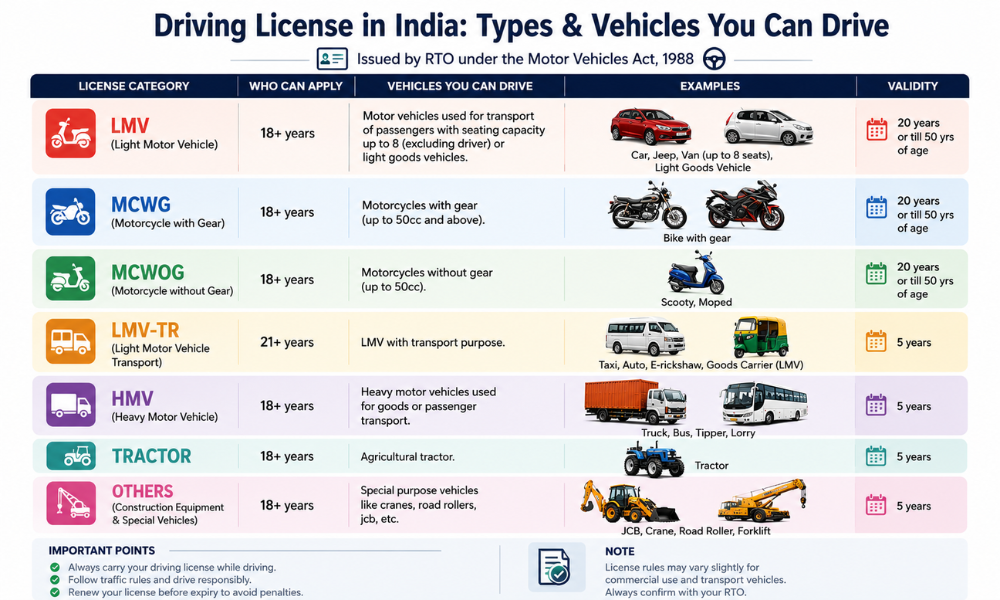
A driving license is more than just an identity card for motorists—it is a legal authorization that permits an individual to operate specific categories of vehicles on Indian roads. Under the Motor Vehicles Act, 1988, every person driving a motor vehicle in India must possess a valid driving license issued by the Regional Transport Office (RTO) or State Transport Authority. However, many people are unaware that not all driving licenses are the same. A license issued for a scooter does not automatically authorize someone to drive a truck, bus, or commercial taxi.
India’s driving license system is divided into multiple categories based on the type of vehicle, its purpose (private or commercial), weight, and passenger capacity. Understanding these categories is essential before applying for a learner’s license or permanent driving license.
This guide explains the different types of driving licenses in India, the vehicles covered under each category, the minimum age requirements, and how to choose the correct license based on your driving needs.
Why Are There Different Driving License Categories?
Different vehicles require different levels of driving skills, road awareness, and safety knowledge. Riding a motorcycle is significantly different from driving a heavy commercial truck or a passenger bus. To ensure road safety, the Indian government classifies licenses according to vehicle type and intended use.
The classification helps ensure that drivers receive appropriate training before operating larger or commercial vehicles.
Types of Driving Licenses in India
- MCWOG (Motor Cycle Without Gear)
MCWOG is issued for gearless two-wheelers with smaller engine capacities, generally scooters and mopeds.
Vehicles Covered
- Gearless scooters
- Mopeds
- Electric scooters (subject to applicable regulations)
- Two-wheelers up to the permitted engine capacity as specified by licensing rules
Examples
- Honda Activa
- TVS Scooty
- Hero Pleasure
- Suzuki Access
Minimum Age
16 years
Applicants below 18 years generally require parental or guardian consent, and eligibility depends on prevailing licensing regulations.
- MCWG (Motor Cycle With Gear)
MCWG allows individuals to ride motorcycles equipped with manual gears as well as gearless scooters.
Vehicles Covered
- Motorcycles
- Sports bikes
- Cruisers
- Scooters
- Motorbikes with manual transmission
Examples
- Royal Enfield Classic
- Bajaj Pulsar
- Hero Splendor
- KTM Duke
- Yamaha FZ
Minimum Age
18 years
This is one of the most common license categories among young riders.
- LMV (Light Motor Vehicle)
The LMV license is one of the most widely issued driving licenses in India.
It authorizes individuals to drive private light motor vehicles.
Vehicles Covered
- Cars
- Hatchbacks
- Sedans
- SUVs
- Jeeps
- Vans
- Pickup vehicles within the prescribed weight limits for LMVs
Examples
- Maruti Suzuki Swift
- Hyundai Creta
- Tata Nexon
- Mahindra Scorpio
- Toyota Innova (private use)
Minimum Age
18 years
This license is primarily intended for non-commercial personal vehicles.
- LMV-TR (Light Motor Vehicle – Transport)
LMV-TR is designed for commercial light motor vehicles used for transporting passengers or goods.
Vehicles Covered
- Commercial taxis
- Tourist cabs
- Auto-rickshaws (where applicable)
- Commercial vans
- Delivery vehicles
- Light passenger transport vehicles
Examples
- Taxi services
- Commercial passenger cars
- Light goods carriers
Minimum Age
20 years (subject to current licensing regulations and training requirements)
Applicants may also need to satisfy additional eligibility conditions prescribed by the transport authorities.
- HMV (Heavy Motor Vehicle)
Heavy Motor Vehicle licenses are issued for operating large commercial vehicles.
Vehicles Covered
- Large trucks
- Dumpers
- Tankers
- Concrete mixer trucks
- Heavy commercial vehicles
Minimum Age
18 years or as prescribed under current transport regulations, along with any required training and endorsements.
Operating heavy vehicles requires specialized driving skills because of their size, weight, braking distance, and road handling characteristics.
- HGMV (Heavy Goods Motor Vehicle)
This category is specifically meant for transporting goods over long distances.
Vehicles Covered
- Cargo trucks
- Multi-axle trucks
- Container trucks
- Freight carriers
- Heavy trailers
Examples
- Logistics transport trucks
- Long-haul cargo vehicles
Minimum Age
18 years or as specified by prevailing licensing norms
Drivers usually undergo professional training before obtaining this license.
- HPMV (Heavy Passenger Motor Vehicle)
HPMV licenses authorize drivers to operate heavy passenger vehicles.
Vehicles Covered
- Public buses
- Luxury coaches
- Tourist buses
- School buses (subject to additional requirements)
Examples
- State transport buses
- Private travel buses
- Intercity coaches
Minimum Age
20 years (subject to applicable regulations)
Passenger safety is the highest priority for drivers holding this licence category.
- Tractor License
Individuals engaged in agriculture often require a tractor license.
Vehicles Covered
- Agricultural tractors
- Farm utility tractors
Minimum Age
18 years
A standard LMV license may permit certain tractor use depending on the vehicle classification and applicable state regulations, but users should verify local RTO rules.
- Engineering Vehicle License
This license is issued for specialized construction and engineering equipment.
Vehicles Covered
- JCB machines
- Bulldozers
- Road rollers
- Excavators
- Construction equipment vehicles
Minimum Age
18 years
Many employers also require additional operator certification for these machines.
Learner’s License vs Permanent Driving License
Before obtaining a permanent driving license, applicants must first receive a Learner’s License (LL).
Learner’s License
- Valid for a limited period as prescribed by law.
- Allows individuals to practice driving under prescribed conditions.
- Requires displaying an “L” sign on the vehicle.
- Driving should comply with learner-license rules.
Permanent Driving License
After completing the mandatory waiting period and passing the driving test conducted by the RTO, applicants become eligible for a permanent driving license.
How to Choose the Right Driving License Category
Choosing the correct category depends entirely on the type of vehicle you intend to drive.
| Vehicle Type | Appropriate License |
| Gearless Scooter | MCWOG |
| Motorcycle with Gear | MCWG |
| Private Car | LMV |
| Taxi or Commercial Car | LMV-TR |
| Heavy Truck | HMV / HGMV |
| Bus | HPMV |
| Tractor | Tractor License |
| JCB / Road Roller | Engineering Vehicle |
Applying for the wrong category may prevent you from legally operating the intended vehicle.
Important Rules Every Driver Should Know
Regardless of the license category, every driver should follow these important rules:
- Always carry a valid driving license while driving.
- Ensure the vehicle is properly registered and insured.
- Obey traffic signs and speed limits.
- Never drive under the influence of alcohol or drugs.
- Wear a helmet while riding two-wheelers.
- Use seat belts in cars.
- Renew your license before its expiry date.
- Do not drive a vehicle outside the category authorized on your license.
Failure to comply with these requirements may result in penalties, suspension of driving privileges, or legal action under the Motor Vehicles Act.
Documents Commonly Required for a Driving License
Although requirements may vary slightly by state, applicants generally need:
- Proof of identity
- Proof of address
- Proof of age
- Passport-size photographs (if required)
- Aadhaar Card, Passport, Voter ID, or other accepted documents
- Learner’s License (for permanent license application)
- Medical certificate where applicable, particularly for certain commercial vehicle categories
Many states also allow applicants to complete significant portions of the application process through the official transport portal before visiting the RTO for verification or the driving test.
Final Thoughts
Obtaining the correct driving license is not merely a legal requirement—it is an important step toward ensuring road safety for yourself and others. Each license category in India is designed for a specific class of vehicle, from gearless scooters and motorcycles to private cars, commercial taxis, heavy trucks, buses, tractors, and engineering equipment. Understanding these categories helps you apply for the appropriate license, receive the necessary training, and drive within the limits of the law.
Before applying, assess the type of vehicle you intend to operate, confirm the latest eligibility criteria with your local RTO, and prepare thoroughly for both the learner’s and practical driving tests. A valid license, responsible driving habits, and adherence to traffic regulations are the foundations of safe and lawful driving. By choosing the right driving license category, you not only stay compliant with Indian laws but also contribute to safer roads for everyone.