
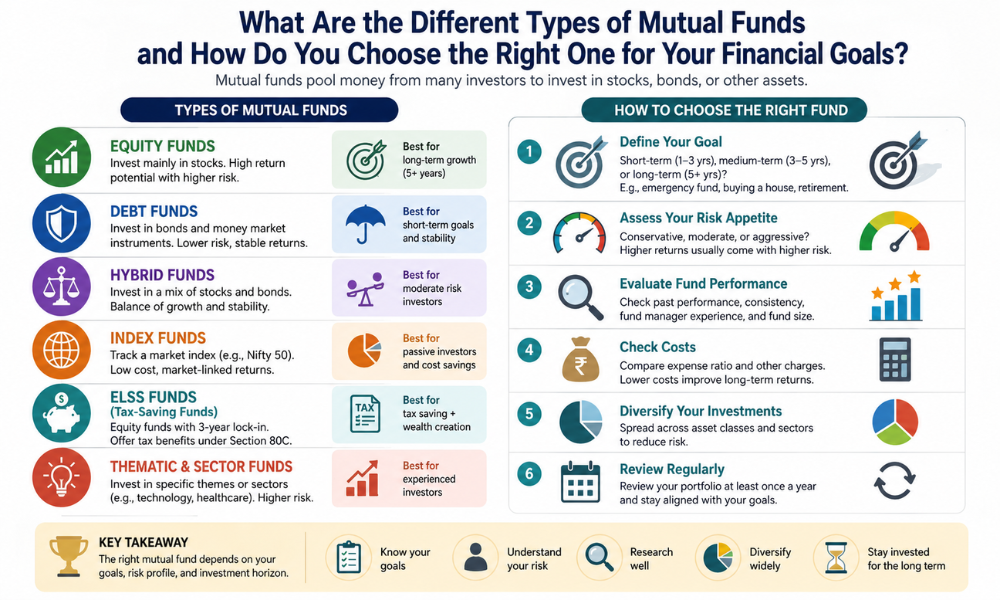
Mutual funds have become one of the most preferred investment options for individuals looking to grow their wealth while benefiting from professional fund management. Whether you are a salaried employee, business owner, retiree, or first-time investor, mutual funds provide an opportunity to invest in a diversified portfolio without needing extensive market knowledge.
However, one of the biggest mistakes many investors make is assuming that every mutual fund serves the same purpose. In reality, different mutual fund categories are designed to meet different financial goals, risk appetites, and investment horizons. Choosing the right mutual fund depends on understanding your objectives rather than simply selecting the fund that has delivered the highest returns in the past.
This guide explains the major types of mutual funds, their features, benefits, and how you can choose the right investment scheme according to your financial goals.
Why One Mutual Fund Doesn’t Fit Every Investor
Every investor has different priorities. Some people invest to build long-term wealth, while others focus on earning regular income, saving taxes, or preserving capital. Factors such as age, income, financial responsibilities, and risk tolerance all influence the ideal investment strategy.
For example:
- A 25-year-old professional can afford to invest aggressively for long-term growth.
- A couple saving for their child’s higher education may prefer a balanced approach.
- A retiree generally looks for stable income with lower risk.
- A taxpayer may prioritize investments that provide tax benefits.
This is exactly why mutual fund companies offer multiple categories of funds.
Major Types of Mutual Funds
- Large Cap Funds
Large Cap Funds invest primarily in well-established companies with large market capitalization. These companies usually have strong financial performance, experienced management, and stable business models.
Suitable For:
- Conservative equity investors
- Long-term wealth creation
- First-time investors
Advantages:
- Lower volatility compared to mid and small-cap funds
- Stable long-term returns
- Strong portfolio diversification
Examples of sectors often included include banking, information technology, FMCG, pharmaceuticals, and infrastructure.
- Mid Cap Funds
Mid Cap Funds invest in medium-sized companies that have significant growth potential.
Suitable For:
- Investors seeking higher returns
- Long-term investment horizon
- Moderate to high risk appetite
Advantages:
- Better growth opportunities than large-cap companies
- Potential for superior long-term returns
Risk:
These funds can experience higher market fluctuations during uncertain economic conditions.
- Small Cap Funds
Small Cap Funds invest in emerging companies with relatively smaller market capitalization.
Suitable For:
- Young investors
- Long-term wealth creation
- High-risk investors
Benefits:
- Exceptional growth potential
- Opportunity to benefit from emerging businesses
Risks:
- High volatility
- Greater market risk
- Suitable only for investors with patience and long investment horizons.
- Flexi Cap Funds
Flexi Cap Funds have the flexibility to invest across large-cap, mid-cap, and small-cap companies based on market opportunities.
Suitable For:
- Investors seeking diversified exposure
- Those who prefer professional asset allocation
Advantages:
- Flexible investment strategy
- Better diversification
- Can adapt according to changing market conditions
- Multi Cap Funds
Unlike Flexi Cap Funds, Multi Cap Funds maintain investments across large, mid, and small-cap stocks according to regulatory requirements.
Best For:
- Balanced equity investors
- Long-term investment planning
Advantages:
- Diversified portfolio
- Reduced concentration risk
- ELSS (Equity Linked Savings Scheme)
ELSS Funds are equity-oriented mutual funds that offer tax benefits under Section 80C of the Income Tax Act.
Benefits:
- Tax deduction up to the applicable Section 80C limit under current tax laws (subject to the tax regime and prevailing regulations)
- Shortest lock-in period among many tax-saving investments (3 years)
- Potential for long-term capital appreciation
Suitable For:
- Salaried professionals
- Taxpayers
- Long-term investors
- Index Funds
Index Funds aim to replicate the performance of a market index such as the Nifty 50 or Sensex.
Instead of trying to outperform the market, these funds simply follow the index composition.
Advantages:
- Lower expense ratio
- Transparent investment strategy
- Passive investing
- Consistent market-linked returns
Suitable For:
- Beginners
- Long-term investors
- Low-cost investment seekers
- Debt Funds
Debt Funds invest in fixed-income securities such as government securities, treasury bills, corporate bonds, and money market instruments.
Suitable For:
- Conservative investors
- Short-term financial goals
- Capital preservation
Benefits:
- Lower volatility
- Stable income
- Better liquidity compared to many traditional fixed-income investments
- Hybrid Funds
Hybrid Funds combine equity and debt investments within a single portfolio.
Benefits:
- Balanced risk
- Better diversification
- Suitable for moderate investors
Best For:
- Investors who want growth along with relatively lower volatility
- First-time mutual fund investors
- International Funds
International Mutual Funds invest in companies located outside India.
Advantages:
- Global diversification
- Exposure to international businesses
- Currency diversification
Suitable For:
- Experienced investors
- Long-term wealth diversification
Choosing the Right Mutual Fund Based on Your Financial Goals
Selecting the right mutual fund begins with identifying the purpose of your investment.
Young Investors
Individuals in their 20s and early 30s generally have a longer investment horizon and can tolerate higher market fluctuations.
Suitable choices include:
- Large Cap Funds
- Mid Cap Funds
- Small Cap Funds
- Flexi Cap Funds
Child’s Education
If you are planning for higher education expenses over the next 10–15 years, consider:
- Hybrid Funds
- Flexi Cap Funds
- Large Cap Funds
These options offer a balance between growth potential and risk.
Tax Saving
If reducing taxable income while building long-term wealth is your objective, ELSS Funds remain one of the most popular options due to their equity exposure and three-year lock-in period.
Retirement Planning
Retirement planning requires balancing wealth creation during your working years with capital preservation as retirement approaches.
A gradual shift from equity-oriented funds to debt or hybrid funds can help manage risk while supporting long-term financial needs.
International Exposure
If your portfolio already has sufficient Indian equity investments, adding International Funds can provide geographic diversification and reduce dependence on a single market.
Factors to Consider Before Investing
Before selecting any mutual fund, evaluate the following:
Investment Goal
Clearly define whether your objective is wealth creation, tax saving, retirement planning, education funding, home purchase, or regular income.
Risk Appetite
Understand how much market fluctuation you can comfortably tolerate. Higher potential returns often come with higher risk.
Investment Horizon
Long-term goals generally allow greater exposure to equity funds, while short-term goals may be better suited to debt-oriented investments.
Fund Performance
Review a fund’s long-term performance across different market cycles instead of focusing only on recent returns.
Expense Ratio
Lower expense ratios can improve long-term returns, especially for passive investment options such as index funds.
Fund Manager and Portfolio Quality
Consider the fund house’s reputation, investment philosophy, portfolio diversification, and consistency over time.
SIP: A Smart Way to Invest
Many investors prefer investing through a Systematic Investment Plan (SIP). SIP allows you to invest a fixed amount at regular intervals, helping build financial discipline and reduce the impact of market volatility through rupee-cost averaging. It also makes long-term investing more affordable by eliminating the need for a large lump-sum investment.
Final Thoughts
Mutual funds are not one-size-fits-all investment products. Every category is designed to address specific financial objectives, whether it is long-term wealth creation, tax savings, retirement planning, capital preservation, or global diversification. Instead of chasing short-term returns or following market trends, investors should align their mutual fund selection with their financial goals, investment horizon, and risk tolerance.
A well-planned portfolio often includes a mix of equity, debt, hybrid, and index funds to create balance and resilience. Reviewing your investments periodically and adjusting them as your life goals evolve can help you stay on track toward financial success. By understanding the different types of mutual funds and choosing schemes that match your unique needs, you can make informed investment decisions and build a stronger financial future with confidence.